
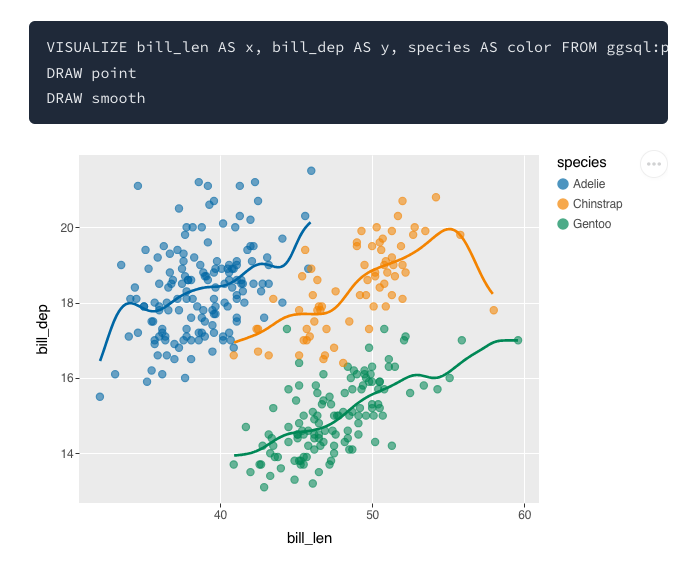
ggsql: A grammar of graphics for SQL. Posit's alpha release of a SQL extension that adds VISUALIZE, DRAW, PLACE, SCALE, and LABEL clauses to build ggplot-style layered graphics directly from a query result, with a DuckDB backend and support in Quarto, Jupyter, Positron, and VS Code. The stated motivations include meeting analysts who live in SQL on their own ground and the observation that LLMs write SQL fluently, which makes the declarative grammar a natural interface for code-assistant-driven visualization.
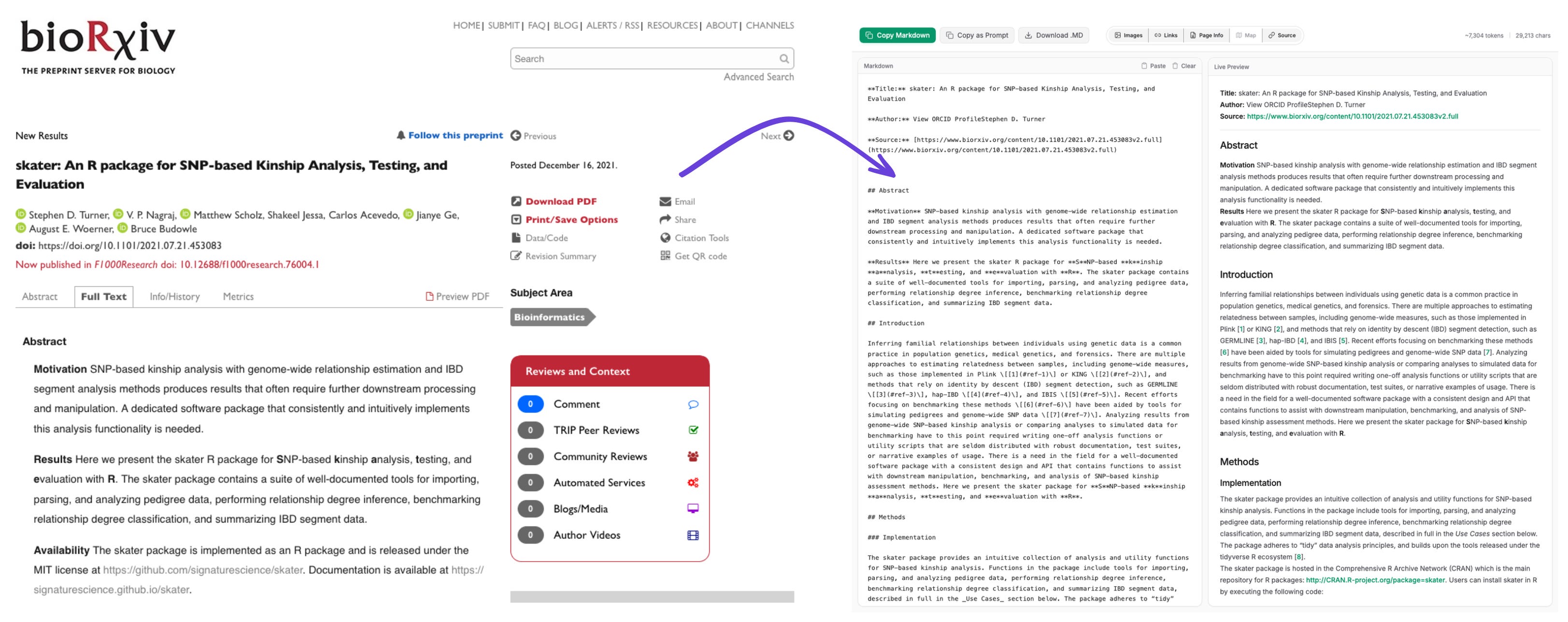
markdownme: Shameless self promotion here. I published a browser extension that instantly turns any page into markdown with a keyboard shortcut (Alt+M by default). You get an editor window and a preview. You can toggle on/off things like a page map, images, links, page metadata. You can install it from the .xpi file on the GitHub release page, or hopefully soon from the Firefox add-on store (the extension is still under review). If you’re using Chrome (why?) see the credits on the GitHub page and use the upstream maintained by someone else. Conversion on most typical pages takes milliseconds.
Matt Lubin: Five Things: Mythos and Glasswing, AI medical advice, GPT-Rosalind, bio-AI models and risks.
GPT-5.5 was released yesterday. I haven’t used ChatGPT in a while, but I plan to spend some more time with Codex because I’ve been chewing through my Claude Code session limits in no time lately. Token anxiety is real. And speaking of…
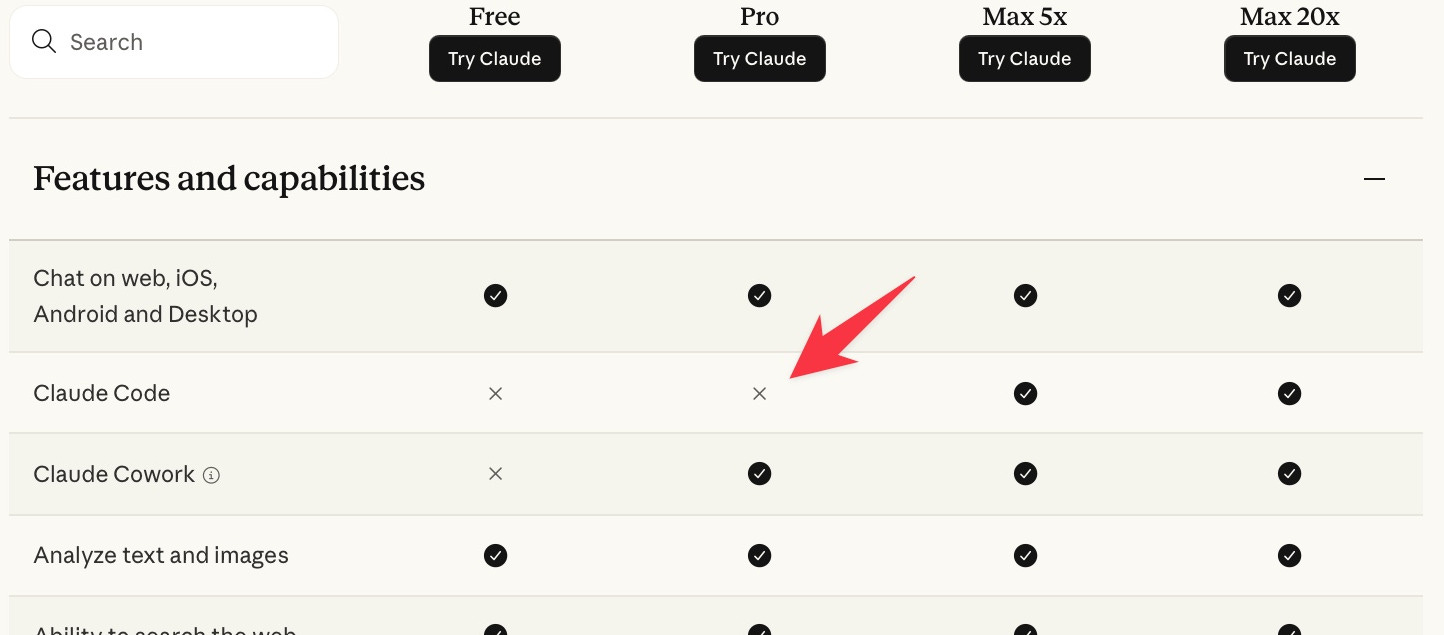
Simon Willison: Is Claude Code going to cost $100/month? Probably not—it's all very confusing. Anthropic silently updated its pricing grid yesterday to remove Claude Code from the $20/month Pro plan and restrict it to Max ($100 and $200 tiers), triggering a several-hour panic across Reddit, HN, and Twitter before reversing the change while Simon was still writing the post. Head of Growth Amol Avasare characterized it as a test on ~2% of new prosumer signups, though Simon (plausibly) thinks that framing doesn't match what people were actually seeing. The piece is less about the specific pricing decision than about how A/B-testing a 5x price increase on a flagship product without any announcement torches trust with the exact audience that teaches and evangelizes the tool; Codex eng lead Thibault Sottiaux capitalized in real time with a promise not to pull the same move. Worth reading as a case study in how much brand damage a canceled experiment can do. I’m a power user of Claude and Claude Code, and now I feel like I’m just waiting for the rug to be pulled.
Policy Changes to SBIR and STTR Foreign Disclosure and Risk Management (NOT-OD-26-074). NIH issued guidance implementing the Small Business Innovation and Economic Security Act, signed April 13, 2026, which reauthorizes SBIR/STTR through 2031 and tightens the foreign risk due diligence regime. The notice enumerates categorical denial conditions (malign foreign talent recruitment program participation, any entity, parent, or subsidiary located in the PRC or another country of concern, foreign affiliation of owners or covered individuals with research institutions in those countries, and appearance on any of eight federal risk lists including UFLPA, BIS Entity List, and CMC lists). HHS will not let applicants cure identified security risks before award denial, and material misstatements or ownership changes post-award trigger full repayment.
Tessa Alexanian: Ideas for AI x Bio Hackathon Projects. A practitioner’s wishlist ahead of this weekend’s Apart Research AIxBio Hackathon, from someone who actually operates a DNA screening tool (Commec at IBBIS). Efficient handling of oligo pools and split orders, assembly signature detection, distinguishing abiological DNA (origami, data storage) from biological sequences, better in-silico functionality scoring for predicted SOC variants, and narrowly-scoped customer screening sub-tools like affiliation and address verification APIs.
Annual flu vaccine no longer required for U.S. military. I made the graphic below indicating casualties in the US military during WWI attributed to combat versus those from influenza.
Q&A: Who’s responsible when AI makes mistakes? A short interview with my awesome colleague David Danks, who joined UVA in January with dual appointments in Philosophy and the School of Data Science. David frames the default accountability trajectory as one where humans become perpetual scapegoats: radiologists signing off on AI diagnoses without being given time to actually second-guess them. David argues for product liability as a starting point, floats the more speculative idea of some form of legal personhood for AI systems so they can carry insurance and have seizable property, and pushes back on the race narrative as partly self-generated by companies rather than a reflection of real economic pressure.
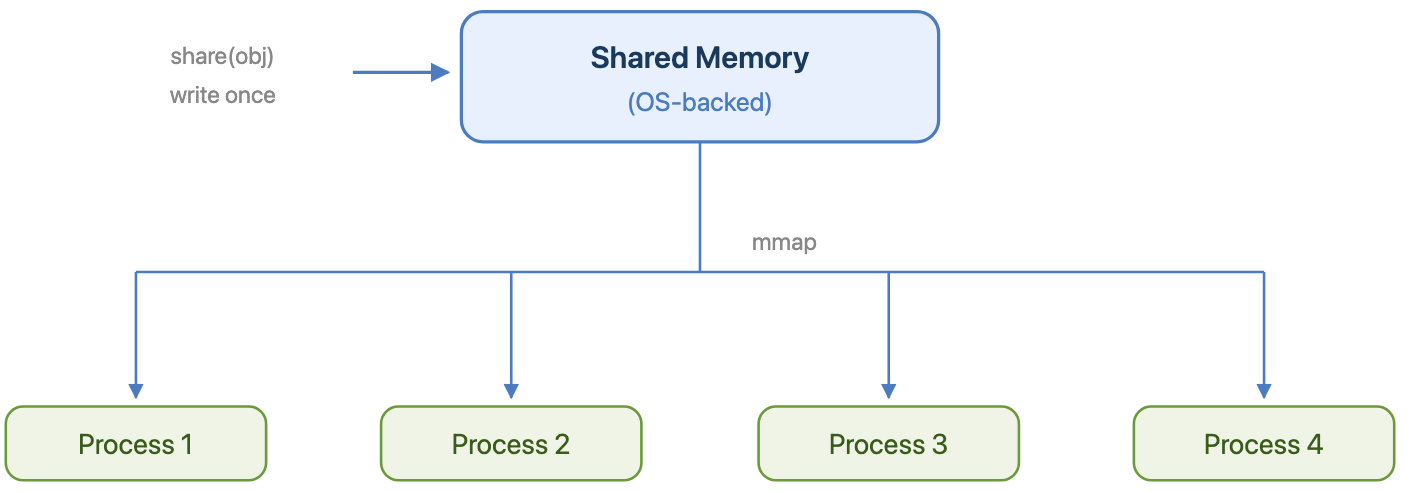
Charlie Gao: mori: Shared memory for R objects. First CRAN release of the mori package that places an R object once into OS-level shared memory and lets every worker on the machine read the same physical pages instead of the usual pattern where eight workers with a 1 GB dataset means 8 GB of RAM plus serialization round-trips. Handles atomic vectors, lists, and data frames (so tibbles, data.tables, factors, and matrices come along for free).
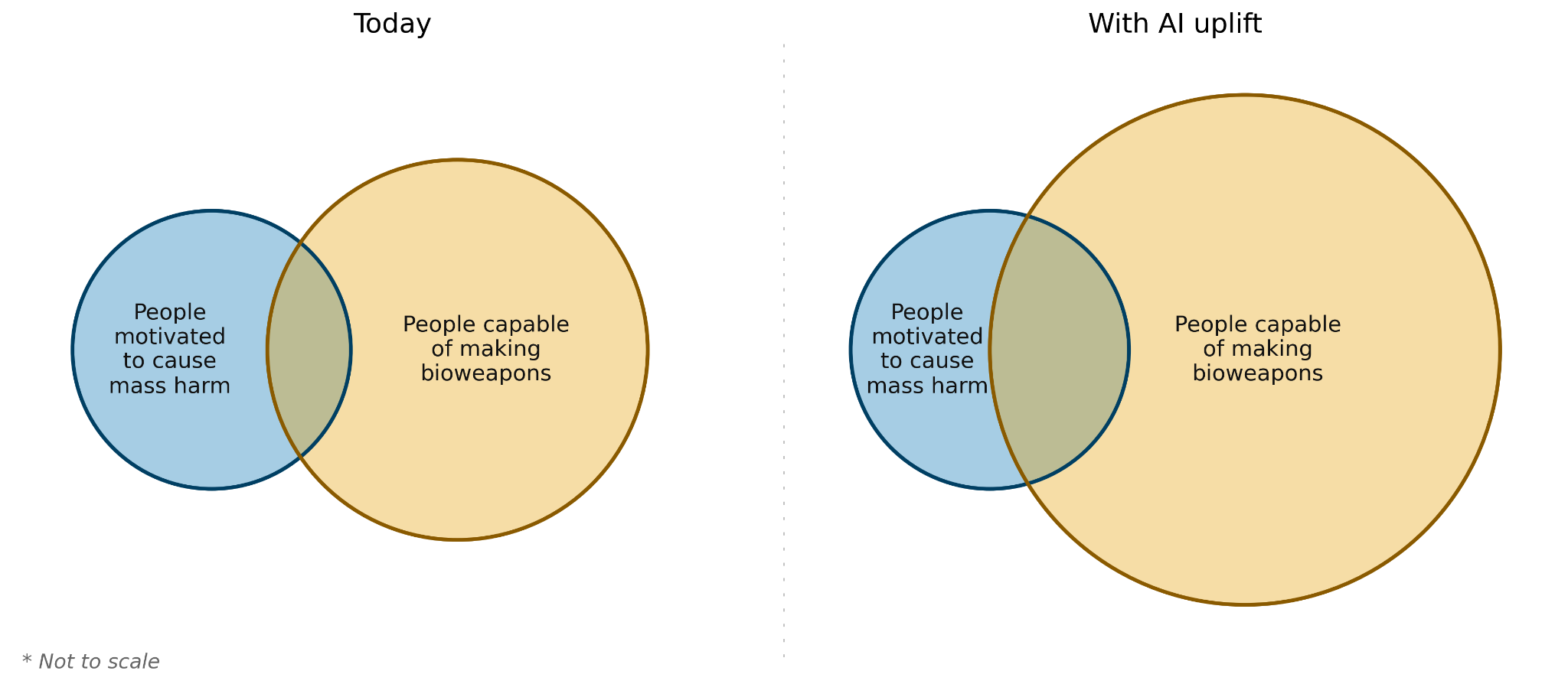
Lennart Justen: A biosecurity playbook for AI companies. A rundown of five levers frontier labs can pull on biorisk: refusals, misuse classifiers, tiered access with KYC screening, training-time knowledge removal (pretraining data filtration, unlearning, Anthropic's Selective Gradient Masking), and evaluations. Justen pulls useful numbers out of the public record, including Dario Amodei's figure that bioweapons classifiers run around 5% of Anthropic's inference cost and OpenAI's disclosure that safety reasoning can hit 16% during new model rollouts, and draws a sharp analogy between Anthropic's Project Glasswing (vetted-access release of Mythos Preview for cyber defense) and the case for similar gating on biology-capable models.
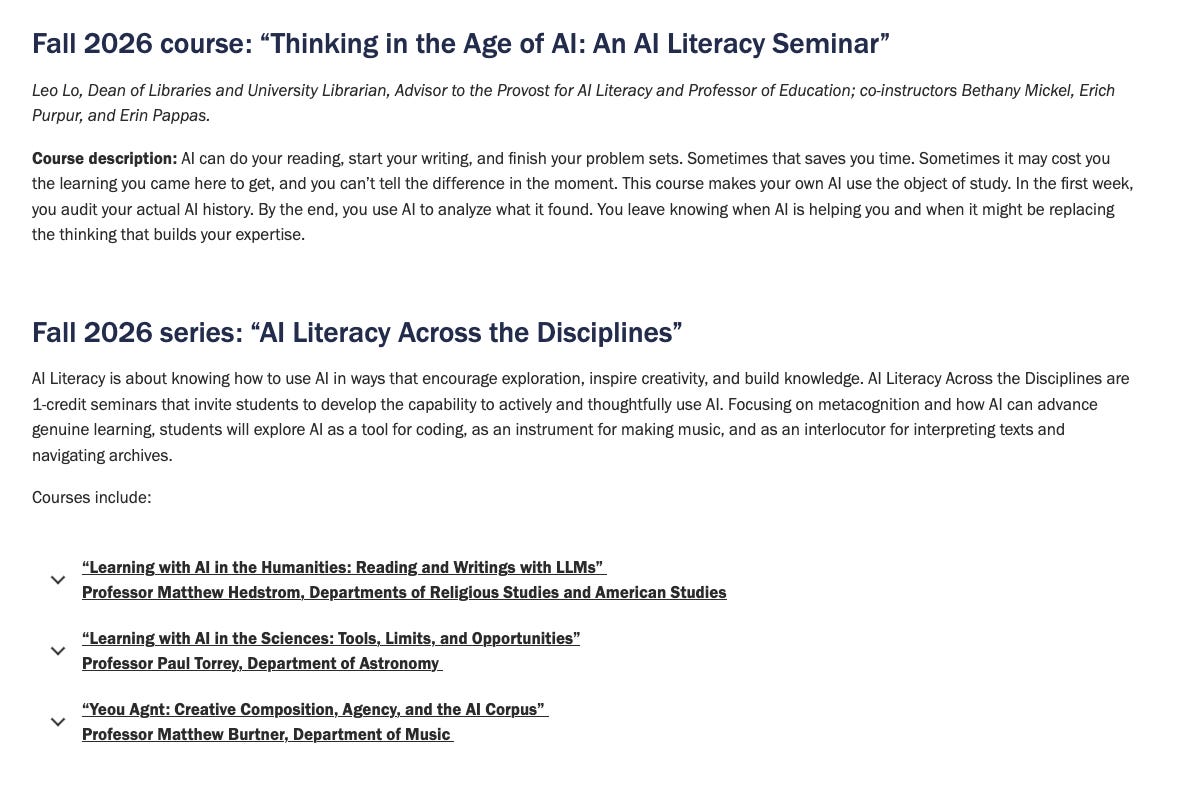
AI Literacy and Action Lab. UVA Library and the College of Arts & Sciences launched a joint program this year that pairs librarians with faculty as instructional partners across five spring/summer pilots, including Anton Korinek's economics course on AI and the future of work (with hands-on sessions using Claude Code, Google Antigravity, and Codex), Piers Gelly's first-year writing course partnering with a local high school, and early-stage plans with David Danks in the School of Data Science and Andreas Gahlmann in Chemistry. The Lab treats each pilot as a publishable case study with pre/post assessment data, aimed at contributing to a national evidence base for AI literacy in higher education.
NIH Highlighted Topic: Computational Modeling of Complex Processes Across Biological Scales. A new NIH Highlighted Topic posted April 17, open through April 2027, encouraging investigator-initiated work on computational models that span molecular, cellular, organismal, and epidemiologic scales, with explicit emphasis on replicability, reproducibility, and model reuse. The topic positions multiscale models as a component of Novel Alternative Methods for evaluating mechanism and safety of interventions in preclinical, translational, and clinical development, which aligns with the FDA's ongoing push to reduce animal testing. Highlighted Topics are NIH's lighter-weight priority signal (not a NOFO; applicants go through a Parent Announcement), with ICO funding dependent on availability and meritorious applications. Central contact is Reed Shabman at NIAID.
Purpose: This topic encourages innovative research in computational modeling of complex processes across biological scales (i.e., to develop multiscale models). The topic seeks to build a collaborative community of researchers to improve the replicability and reproducibility of computational multiscale models, promoting their advancement and reuse.
Background: Multiscale computational models that integrate processes across different spatial and temporal levels, from molecular to organismal, to epidemiologic and from microseconds to years. They provide a comprehensive understanding of complex systems and offer an exciting opportunity to advance biomedical research. This approach helps reveal how interactions at molecular and cellular scales influence larger, population-, geographical-, or global-scale phenomena, offering insights into complex biological processes, and may help develop better and more precise biomedical interventions. By integrating processes from molecular to epidemiologic levels, multiscale computational models provide a comprehensive understanding of complex systems. This topic encourages innovative research and collaborative approaches that integrate technologies and informatic practices to develop, improve, and disseminate multiscale computational models for human health and diseases, and their associated technologies, across the research community. The topic also supports leveraging computational multiscale models as an important component of Novel Alternative Methods (NAMs) to investigate the mechanism and safety of a medical intervention in pre-clinical, translational, and clinical development.
Qwen3.6-35B-A3B: Agentic Coding Power, Now Open to All. I started last week’s newsletter with “another week, another new model” where I talked about Claude Opus 4.7 and OpenAI’s GPT-Rosalind. Alibaba's Qwen team just released a new open-weight MoE model with 35B total and 3B active parameters, Apache 2.0 licensed, targeting agentic coding and repo-level reasoning. I hit my Claude token limits while working on a textbook, and switched over to using this local model in Claude Code1 on my 48GB MBP. As much as I’d have loved this to work well, it absolutely did not when compared to just using Sonnet.
Elizabeth Ginexi: The Executive Orders Blocking Your NIH Grant. A 22-year NIH program official walks through the mechanics behind the funding slowdown that followed Congress's FY26 $47 billion appropriation, tracing the pipeline from EO 14168 and the August 7, 2025 “Improving Oversight of Federal Grantmaking” EO through NIH's implementation notices (NOT-OD-25-131, NOT-OD-26-009), the Unified Strategy, and the elimination of paylines as funding cutoffs. The piece discusses the requirement that political appointees personally approve NOFOs and discretionary awards, the termination clause that now applies to renewals and continuations, and the provision that court victories only bind NIH for the specific plaintiffs who sued. Ginexi also documents the collapse in new NOFOs (756 in 2024, 17 through mid-March 2026) and the shift from direct indirect-cost caps (struck down in court) to preference-based screening at the appointee review stage.
And ICYMI, I published several posts here this week.


New papers & preprints:
You can run Claude Code with local models via Ollama. E.g.: ollama launch claude --model qwen3.6