
I’m at the UVA Conference on Ethical AI in Business all day tomorrow so I’m sending out my weekly recap a day early. We had a short week in the U.S. last week, but science progress and news didn’t take a break. Lots to catch up on. Happy reading!
Editorial in Science: Accelerating science with AI.
rOpenSci News Digest, November 2025.
Nature: Academia is unprepared for the rise in chatbot use among students. Why universities need to radically rethink exams in the age of AI.
AI is Destroying the University and Learning Itself: “Students use AI to write papers, professors use AI to grade them, degrees become meaningless, and tech companies make fortunes. Welcome to the death of higher education.”
R Weekly 2025-W49: Create custom GPS route maps in R; from RUnit to testthat with coding agent support; does running back-to-back individual immunity challenges decrease your chances of surviving the next tribal councils?
R Data Scientist 2025-12-02: R community & news, tools & IDEs, geospatial & mapping, culture & sports data, stats & research methods.
Alexandra Balwit (Asimov Press): A Most Important Mustard — On the origins of Arabidopsis thaliana, the premier model for plant biology.
Elliot Hershberg: On AI Infrastructure in Biology.
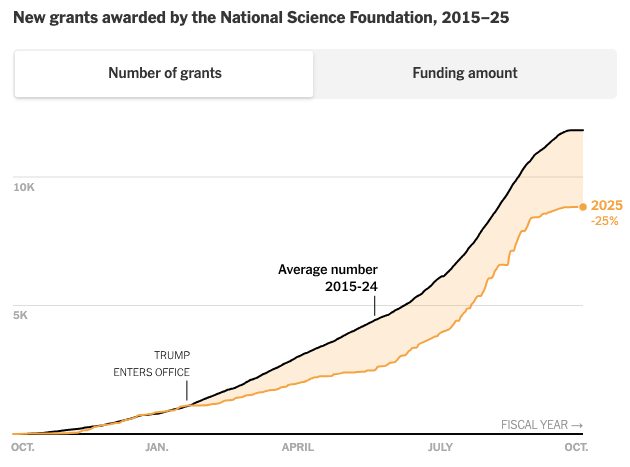
NYT: The U.S. Is Funding Fewer Grants in Every Area of Science and Medicine.
OpenAI launches grant program for new research into AI and mental health. Introducing a new program to award up to $2 million to support independent safety and well-being research.
Joe Rickert: October 2025 Top 40 New CRAN Packages: Data, Decision Analysis, Ecology, Econometrics, Finance, Genomics, Logic, Machine Learning, Mathematics, Medical Statistics, Statistics, Time Series, Utilities, and Visualization.
Intro to Bedder (successor to bedtools).
Posit’s progress and renewed commitment to the Open Source Pledge. Posit pledged to invest at least $2,000 per developer (they have 160). They exceeded that by a lot, contributing over $750,000 (~$4,700 per developer) to open-source projects and organizations, including NumFOCUS ($129k), DuckDB Foundation ($119k), R Consortium ($100k), Eclipse Foundation ($57k), Linux Foundation ($22k), R Foundation ($10k), and many individual contributors working on things like R Markdown and pandoc.
The Thinking Game. This feature-length documentary on YouTube follows Demis Hassabis’s pursuit of AGI from AlphaGo to AlphaFold.
I’m an A.I. Developer. Here’s How I’m Raising My Son.
Parsing PDFs with Antigravity.
Major AI conference flooded with peer reviews written fully by AI. Controversy has erupted after 21% of manuscript reviews for an international AI conference were found to be generated by AI.
A ChatGPT prompt equals about 5.1 seconds of Netflix.
Nature: China wants to lead the world on AI regulation.
Plasmidsaurus RNA-seq Service Sparks Interest From Researchers, Unease From Academic Cores. I used Plasmidsaurus in my previous position at Colossal. There’s that old saying: fast, cheap, high-quality — pick 2. Not so with Plasmidsaurus; you get all three. I promise I have no affiliation with them. Plasmidsaurus is now offering RNA-seq at $50/sample with a turnaround time of 3 days. The service comes with some basic analysis, and (according to the GenomeWeb article) an interactive portal for analyzing the data yourself.
Accepted papers from the NeurIPS 2025 Workshop on Biosecurity Safeguards for Generative AI (BioSafe GenAI 2025).
NeurIPS 2025 Workshop on Biosecurity Safeguards for Generative AI

The 2025 NeurIPS Workshop on Biosecurity Safeguards for Generative AI will take place December 6, 2025 in San Diego. The theme of the workshop on AI & the Bio-Revolution is Innovating Responsibly, Securing Our Future.
Michael DePeau-Wilson at Asimov Press: Why the FDA Is Slow to Remove Drugs: On the 90-year saga of oral phenylephrine.
Dhruv Khullar at the New Yorker: The Undermining of the C.D.C.
OpenAI launched an alignment research blog: alignment.openai.com. It looks a lot like Anthropic’s: red.anthropic.com.
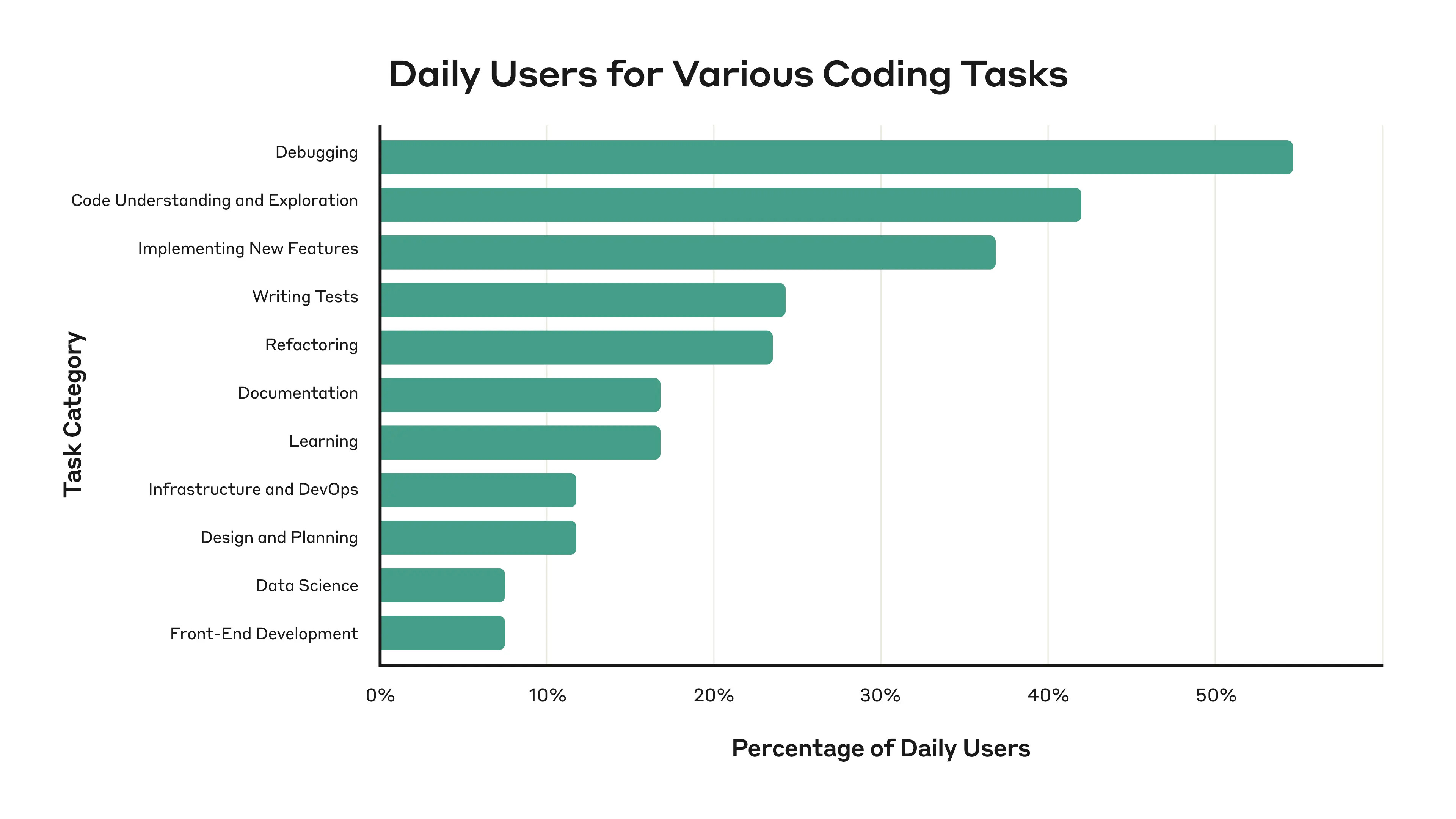
How AI Is Transforming Work at Anthropic: Survey of 132 engineers + 200k Claude Code sessions: engineers lean on Claude first for questions, changing team dynamics; the company plans wider internal study and organizational responses.
New paper from the Nuclear Threat Initiative (NTI): Redefining Biological Weapons: Expanding the BWC to Incorporate Infrastructure Harm and Cyber-Biothreats.
(Humor) I Need AI to Write Better Lesson Plans So My Students Stop Using AI to Write Their Papers.
Finally, a few other papers and preprints that caught my attention this week:
Optimized k-mer search across millions of bacterial genomes on laptops
Eduomics: a Nextflow pipeline to simulate -omics data for education
Mapping spatial gradients in spatial transcriptomics data with score matching
LorMe: a streamlined and interoperable R framework for end-to-end microbiome analysis
polars-bio - fast, scalable and out-of-core operations on large genomic interval datasets