
This is a cross-post of an article I originally wrote last month for AI Exchange @ UVA.

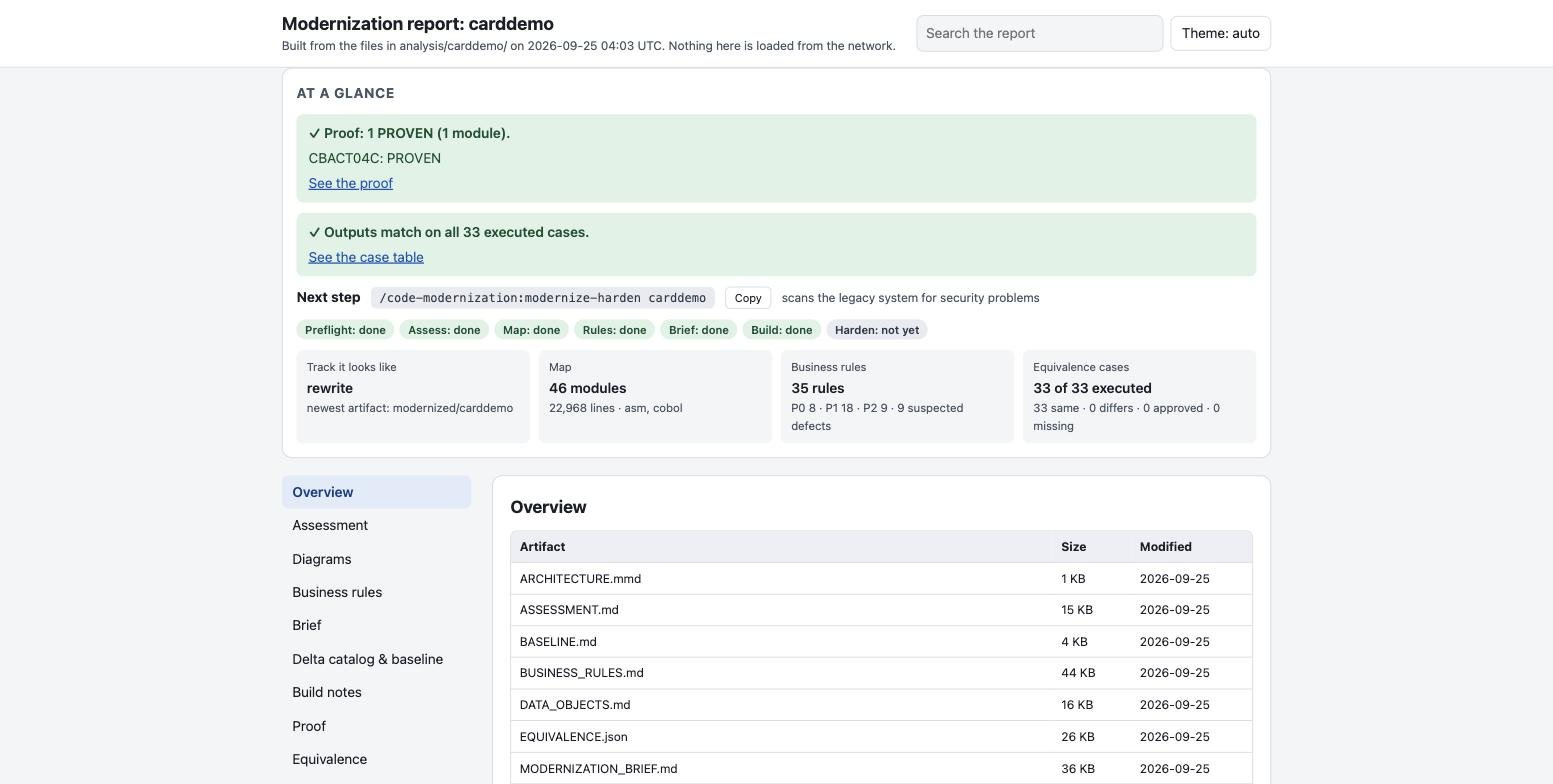
I recently found the code modernization plugin for Claude Code. It provides a workflow for updating “legacy” software, rewriting it in another language or rebuilding its architecture. Extensive docs are in the README. You can install it with /plugin install code-modernization@claude-plugins-official, then start with /code-modernization:modernize. You can also choose an assessment without rebuilding anything, which I suppose might be useful for an inherited scientific codebase whose original developer has left (common in academia, when a postdoc leaves, maintaining some software is no longer in their job description).
For a rewrite, Claude analyzes the code base, maps dependencies, extracts behavior into testable rules with source citations. You approve a modernization plan before implementation, then the workflow writes analysis and modernized code. There’s a verification step that compares old and new implementations on identical inputs, with declared tolerances for floating-point results. Claude goes on to generate additional edge cases and introduces deliberate defects to check that tests catch them. It’ll give you verdicts of PROVEN, PARTLY PROVEN (with what is missing) or NOT PROVEN (nothing ran, something differs, a test fails) from whatever if finds.
Rewrites in bioinformatics
This has been happening for a while now in my own field of computational biology. Skip down to the next section if comp bio / bioinformatics isn’t your thing!
RustQC is a suite of fast QC tools for sequencing data, compiled to a single static binary with no runtime dependencies, running much faster than “legacy” tools.

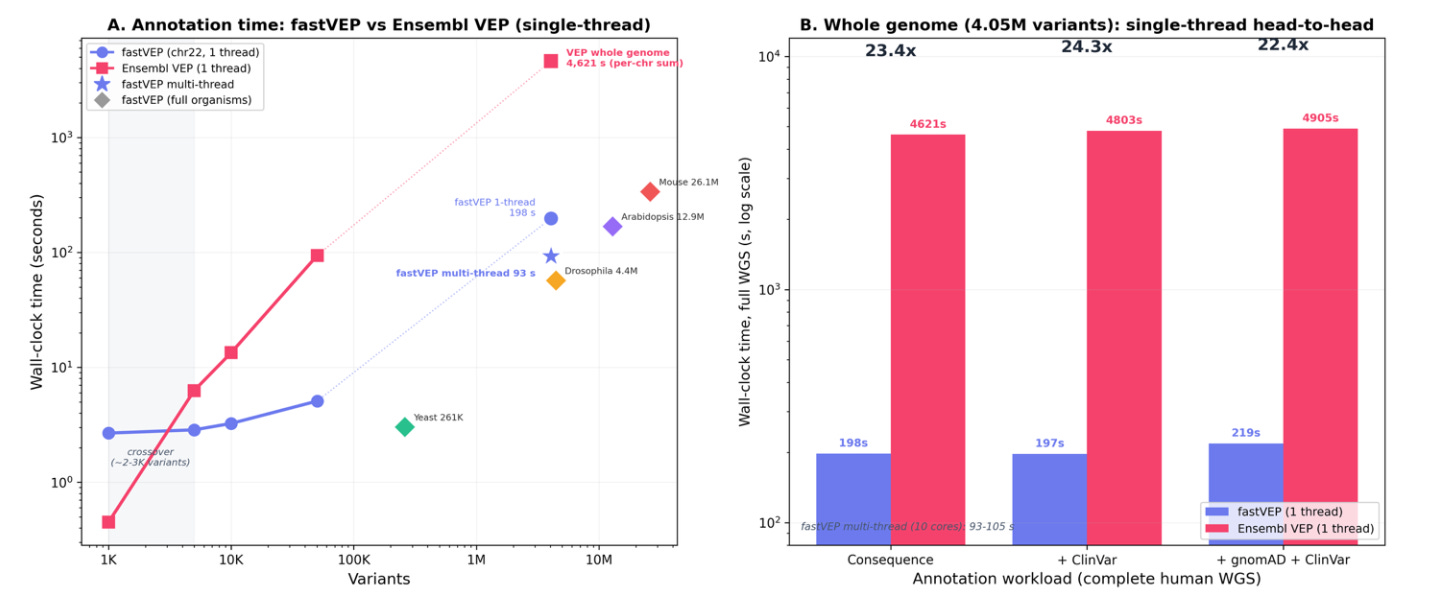
fgumi reimplements UMI processing functionality from fgbio. fastVEP implements variant annotation in Rust much faster than the OG VEP.
The rewrites.bio manifesto from the fine folks at Seqera proposes expectations like crediting original authors, pinning the versions being compared, validation on real data, planning for continued maintenance, and so on.
OpenAI’s Scientific computing in the age of agentic AI field report documents several additional case studies. Contributors reported that RustQC cut runtime from 15 hours to 15 minutes on one dataset, mostly by reducing repeated processing and I/O. FastQC, which everyone in this field has used forever, was sped up several fold by rewriting the original Java implementation in Rust. Several other examples in this paper.
Heng Li’s “The AI Rewrite Dilemma” addresses the people responsible for these rewrites. He welcomes rewrites of his tools and sees benefits in performance and deployment, while also acknowledging maintainers’ discomfort. There are only a few pieces of my own software I actively maintain. I’m not sure how I’d feel if someone proposed a massive PR or created an independent fork in a language or framework I don’t know or understand. Or maybe that’s okay and we just lean into the fact that coding agents are better than most of us at writing most code these days.
Beyond bioinformatics
All this goes beyond science. Software is no longer a moat.
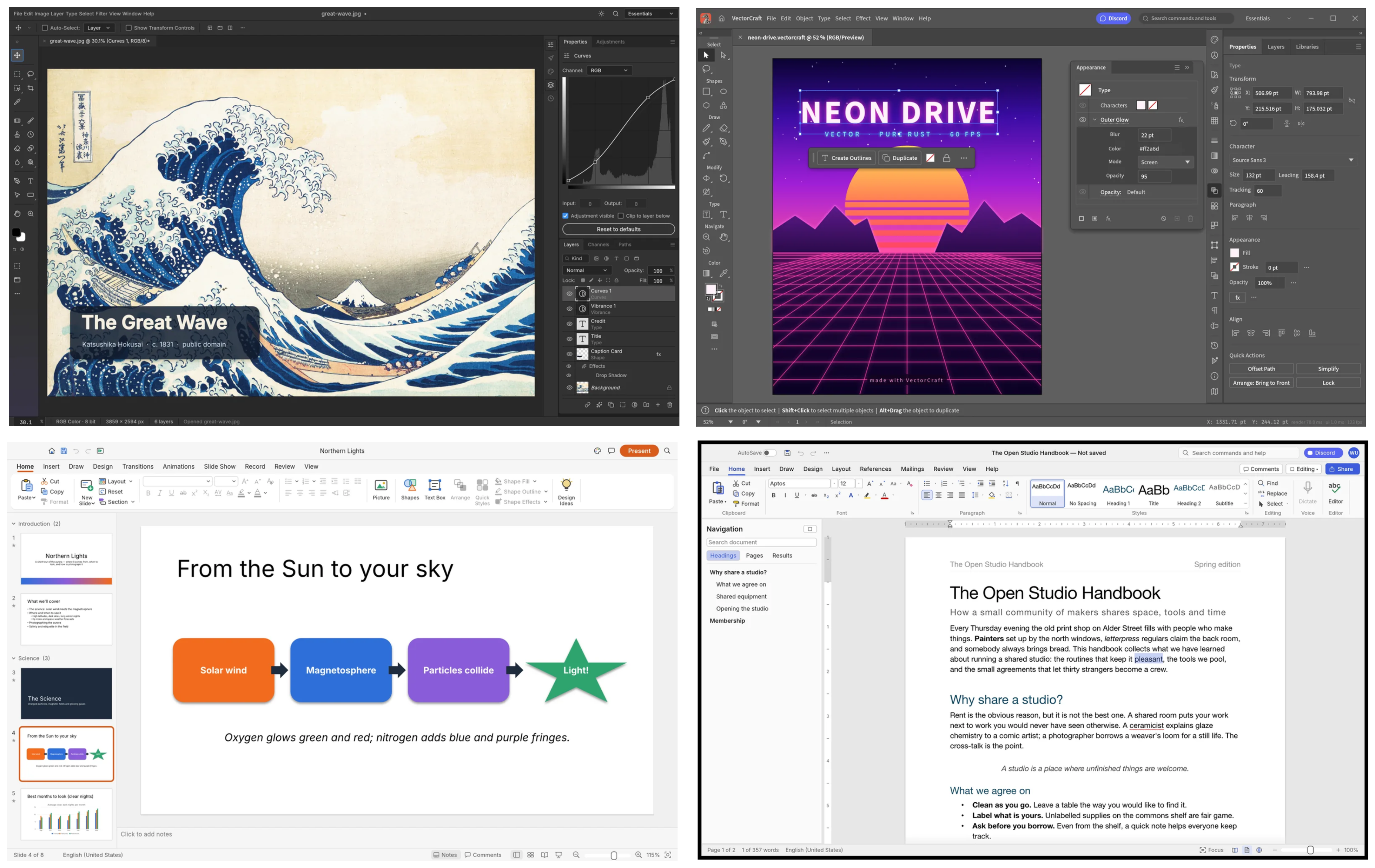
The internet is abuzz with ArtCraft’s Crafting Apps that apply the same approach to desktop software. In the past few weeks the team released Rust reimplementations of Photoshop (PhotoCraft), Lightroom (LightCraft), Illustrator (VectorCraft), InDesign (DesignCraft), Acrobat (PdfCraft), AutoCAD (CADCraft) and Office (WordCraft, GridCraft, DeckCraft).1
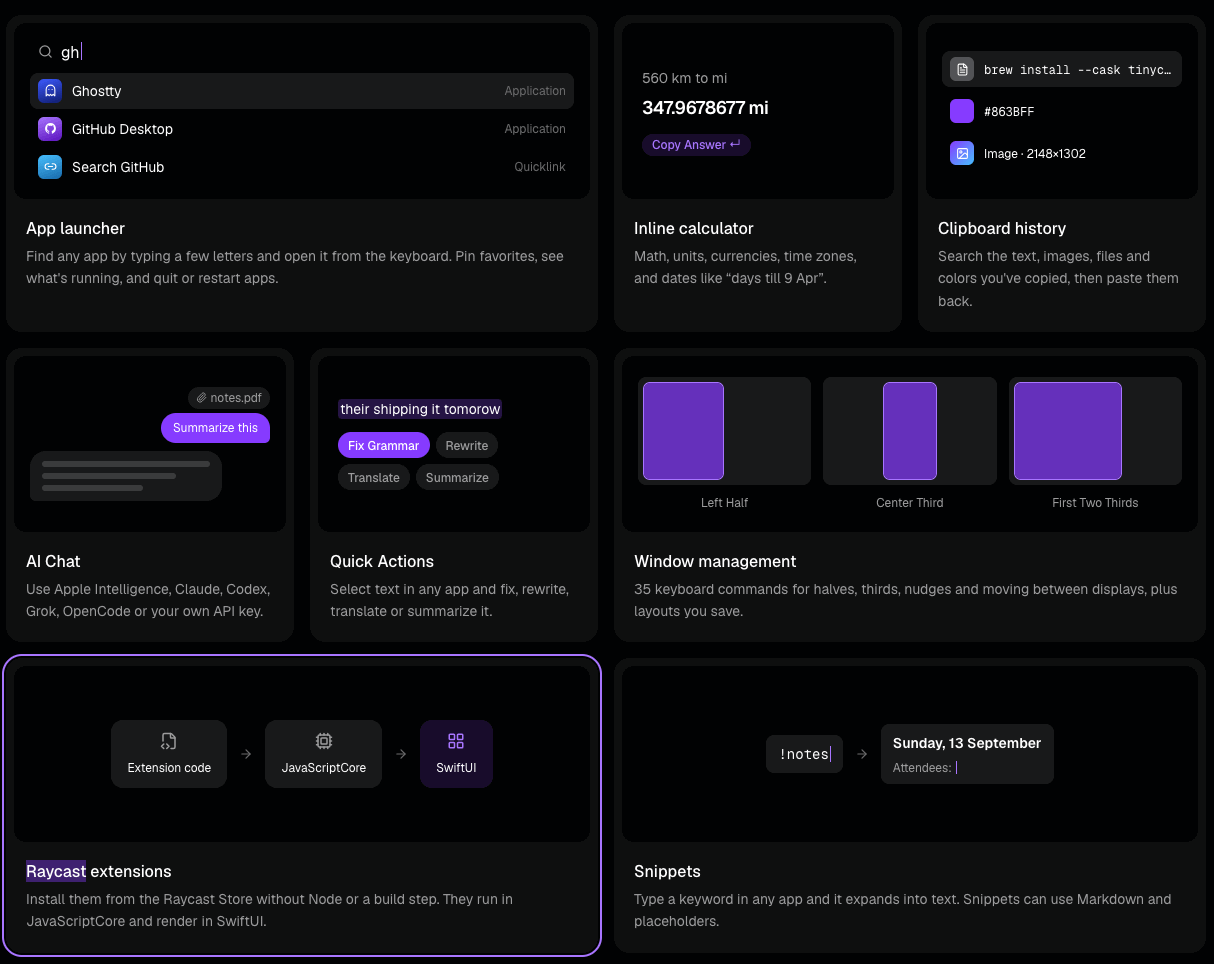
Another example. Long ago I used Alfred as kind of a souped-up spotlight replacement, before switching to Raycast, what I use now. Raycast is great, but with the latest update it started nagging me about upgrading to get such-and-such AI feature I don’t want. Yesterday I found Tinycast, a tiny, native (Swift+Appkit) reimplementation of Raycast with no Electron, no telemetry, etc. It looks like it does the stuff I want (app launcher, snippets, clipboard history), without any of the stuff I don’t, and can run Raycast extensions out of the box.
You can just build stuff
You can just build stuff now.2
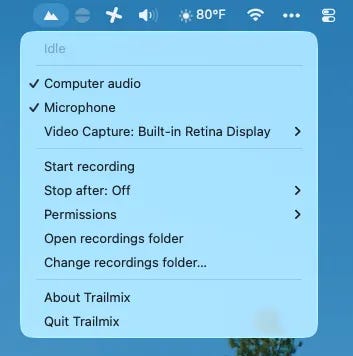
I didn’t want to pay for Granola, so I built Trailmix, a MacOS desktop app that’ll record and transcribe Webinars or meetings where you’re not the host.3 See the source code and the blog post.
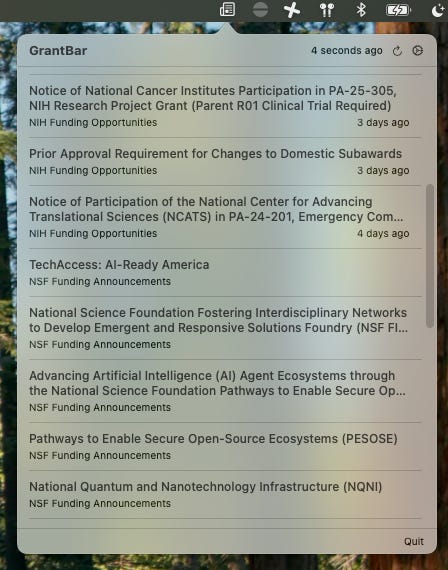
I also built a little MacOS menu bar app called Grantbar that’ll alert me to new opportunities coming from my favorite funders. Sure, not much now, but it’s on my roadmap to customize this to my own interests a little more, add more non-RSS sources, and add some AI-based filtering and prioritization to it (really alert me if there’s something that really matches my interest, especially if there’s a short turnaround time).
In both of these cases I got working software in about a half hour, and I don’t know the first thing about Swift or MacOS desktop application development.4
Something I’m building next, whenever I have time. With my research dean hat on I spend a lot of time working with our faculty, trying to find grant opportunities and match them to the right people, and forming teams to try to pursue larger programs. Except I’m not in a medical school any more where I can just point someone to an NIH Parent Announcement and say godspeed — we have faculty doing all sorts of things from national security to economics to social sciences to quantum computing to medical research, and many, many more specialties. There are a bunch of startups out there (Granted, Atom, Grantsmate, ProposalCentral, Grantflux, Proposia, Streamlyne, and many others) that try to bring some AI automation to this problem. Sure, I could pay for one of these services, but then I’d be locked in with a vendor who doesn’t have a history of support or longevity, waiting for the rug to be pulled at any moment in terms of pricing or features. I have tokens to burn and know what I want. Or even if I didn’t know what I want, I imagine it wouldn’t be too difficult to point Claude/Codex to one of these services and say “build this for me, but make it better.”
The point is: you can just build stuff now.5 Maybe that’s a better/faster/slimmer rewrite of some legacy code, or maybe it’s recreating a commercial product that doesn’t quite suit your needs or costs too much. It’s an interesting new world we live in where you can just conjure into existence whatever software you want, modernize legacy software, or reverse engineer existing software to suit your needs.
There’s even a new dedicated website, Clones Of, that helps you find free clones of existing software: clonesof.com. For now it looks like it’s mostly pointing to those Rust clones of Adobe/Office products.
There was a (very brief) period where people thought “prompt engineer” would be a job. And another brief period where you frequently heard something along the lines of “AI won’t take your job, but someone who’s great at using AI will.” Maybe both of those were viable back in 2024, but these days it doesn’t take much expertise to get a piece of working software out of a sloppy prompt hastily described with voice mode.
As noted in the original blog post, be courteous. Trailmix doesn’t join your meetings like other AI transcription services, so don’t record without permission.
However… I did learn quite a bit along the way.
A distinction. Vibe-coding is almost used as a pejorative these days, but I think there’s a distinction to be made between vibe-coded analysis development, and vibe-coded software development. In data science or “analysis development” - you don’t know what the right answer is, and often you don’t know what the next line of code should be until you run the current line of code, inspect the output, look at some plots, examine some residuals, etc. In software development (at least in terms of personal software I use myself that isn’t some service I’m providing over the internet), the end product is the thing I can verify. Did my grantbar app actually alert me to whatever NSF published on its RSS feed? Did my trailmix app actually record and transcribe that webinar? If so, I don’t personally care if the code is elegant or efficient.