
Don’t reach for ChatGPT Images or Nano Banana as your first option when creating scientific images. Yeah, they’re getting better with every generation, but they still have that imagen look. Personally, when I see GenAI images in a talk or paper, I treat the rest of the talk or paper with more scrutiny and skepticism than I would have otherwise.
Biorender is popular, but the licensing gets murky once you start using those images in publications. Here are some free image libraries, icon sets, and diagramming tools I keep bookmarked for talks, figures, and blog posts.
Images/icons/art:
Phylopic: https://www.phylopic.org/
NIH Bioart: https://bioart.niaid.nih.gov/
Bioicons: https://bioicons.com/
Scidraw: https://scidraw.io/
Open Science Art: https://openscienceart.com/
Health Icons: https://healthicons.org/
Servier Medical Art: https://smart.servier.com/
Biodiversity Heritage Library: https://www.flickr.com/photos/biodivlibrary/
The Noun Project: https://thenounproject.com/
Tools:
Segment Anything: https://aidemos.meta.com/segment-anything/
Excalidraw: https://excalidraw.com/
Draw.io: https://www.drawio.com/
Biographics (freemium): https://biographics.nitro.bio/
Image resources
Phylopic
PhyloPic is a specialized database of silhouette icons of organisms: black-and-white outlines of animals, plants, and microbes (over 10k images as of this writing).
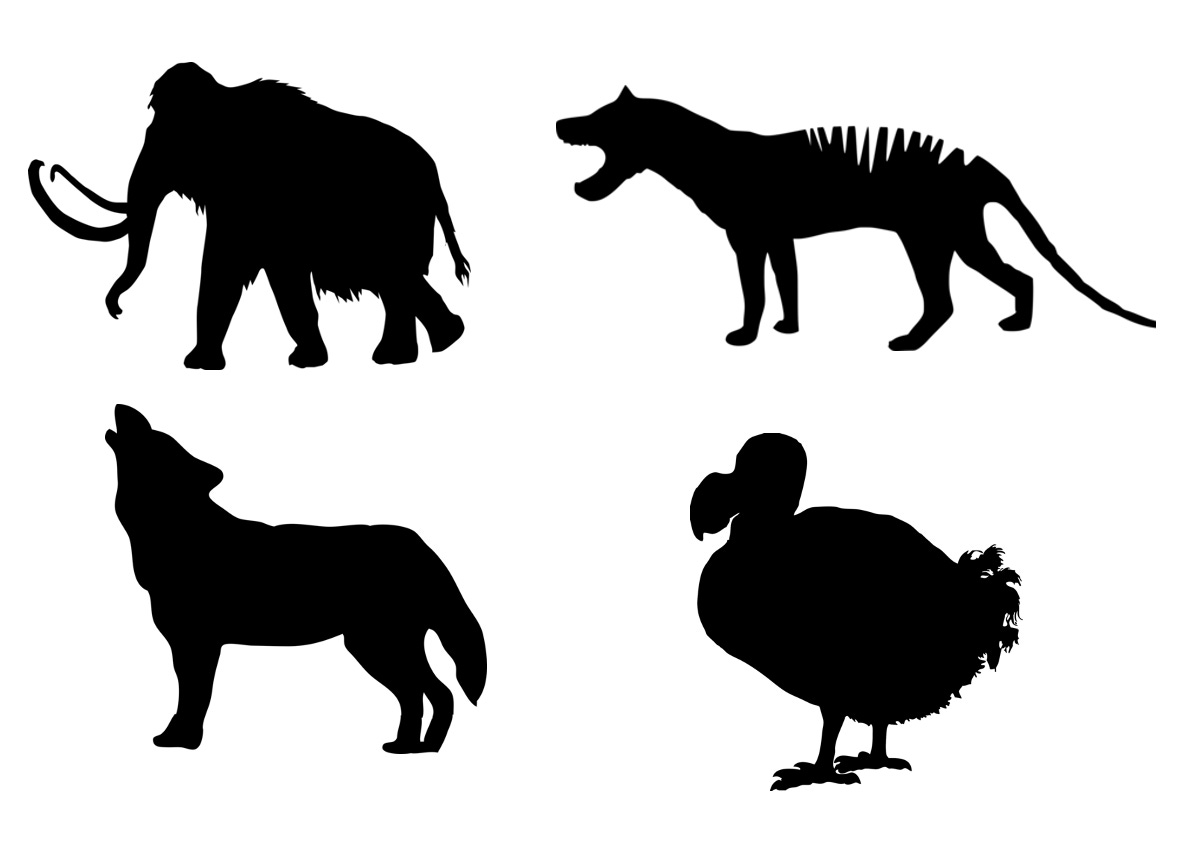
The silhouettes are simple yet immediately recognizable shapes, which is great for scientific schematics like phylogenetic trees, biodiversity charts, or any figure where you want a clear icon of an organism without distracting details. The collection is community-contributed and curated, and images are linked to taxonomy. You can get SVGs or PNGs of any image. Phylopic also has an API, and there’s also the rphylopic R package letting you programmatically use phylopic silhouettes in R graphics, including ggplot2.
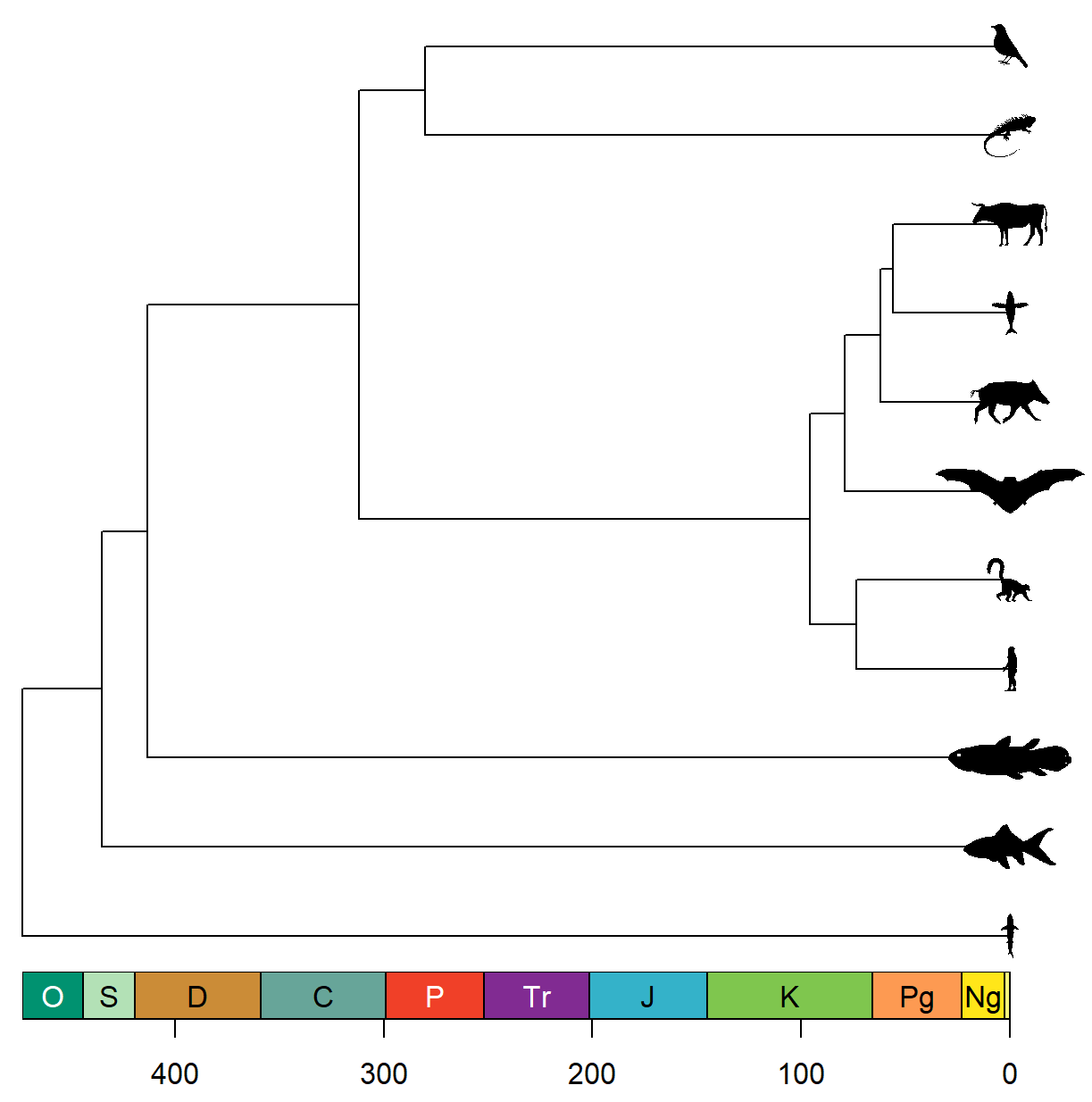
Creative Commons licenses govern the images at Phylopic. Many are public domain, and you can filter your results by the license type (e.g., public domain, free for commercial use, no ShareAlike requirement). Each image on PhyloPic clearly lists its license and creator. In practice, this means you can use most icons freely in publications or presentations; if an image is CC BY, you’ll just need to credit the contributor (which the site makes easy by providing citation info).
NIH Bioart
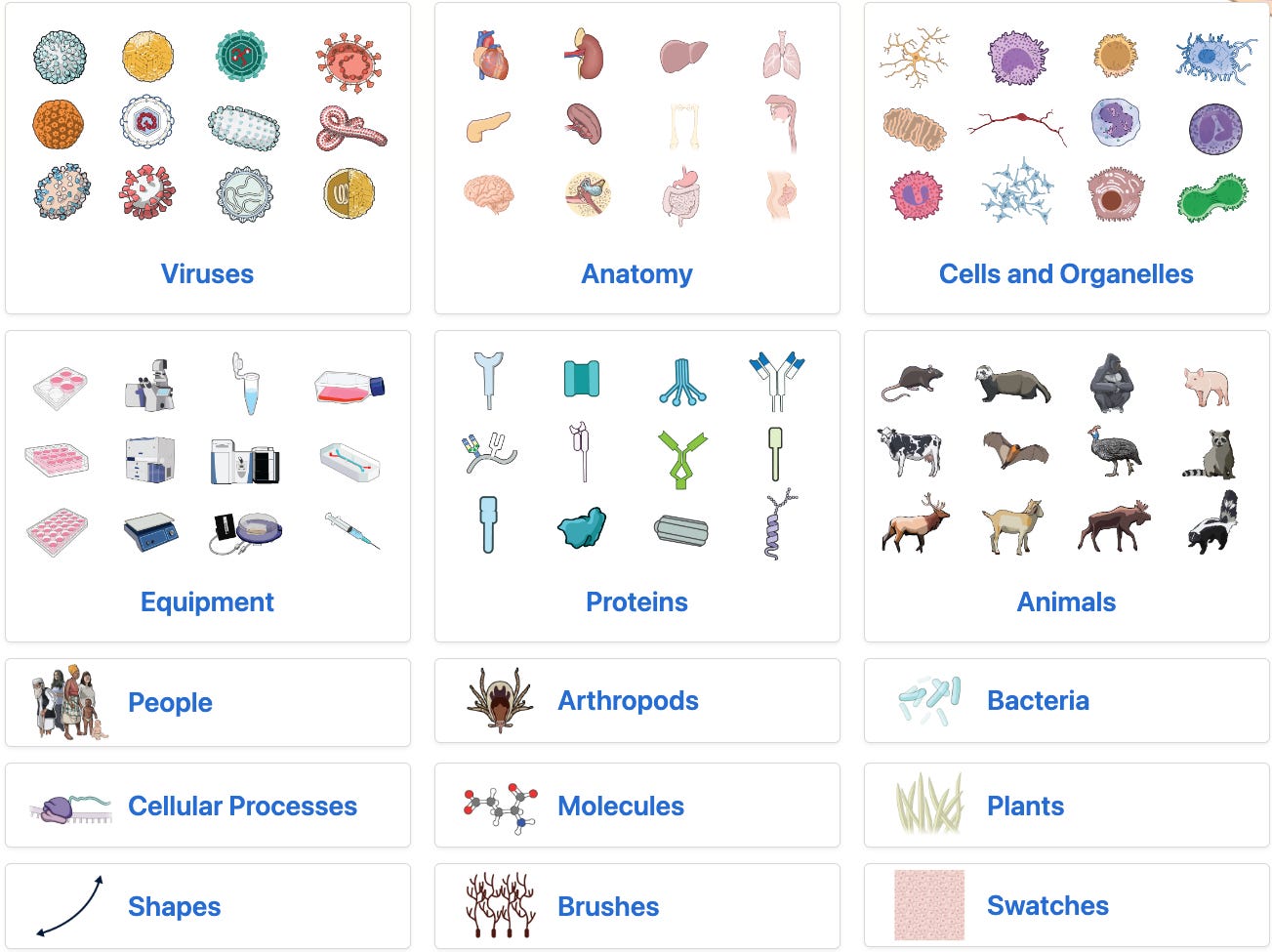
NIH BioArt is a free library of high quality vectors, icons, and brushes created by professional illustrators provided by the National Institute of Allergy and Infectious Diseases (NIAID). There are over 2,000 science and medical art visuals in the collection as of this writing.
The library includes a wide range of scientific imagery: cells and organelles, microbes and viruses, lab equipment, anatomical diagrams, chemical structures, etc. These are scientifically accurate, high-resolution illustrations (often original artwork or sketches) covering many areas of biology and medicine. Most images are available as vector files (SVG, AI, or EPS) in addition to PNG, which means you can edit and scale them freely. The site’s interface lets you filter by category (e.g. “Cells”, “Viruses”, “Laboratory Equipment”) and by format. It also includes some pre-made figure elements like arrows and icons (brushes). Because this is an NIH resource, new content might be added over time and the quality/control is quite high (the art is typically drawn by NIH’s medical illustrators).
All BioART content is public domain: free for any use, with no restrictions. As a U.S. government publication, the illustrations on the BioArt Source are explicitly free for educational, research, informational, and even commercial use. In other words, you can use these images however you wish without worrying about copyright.
Bioicons
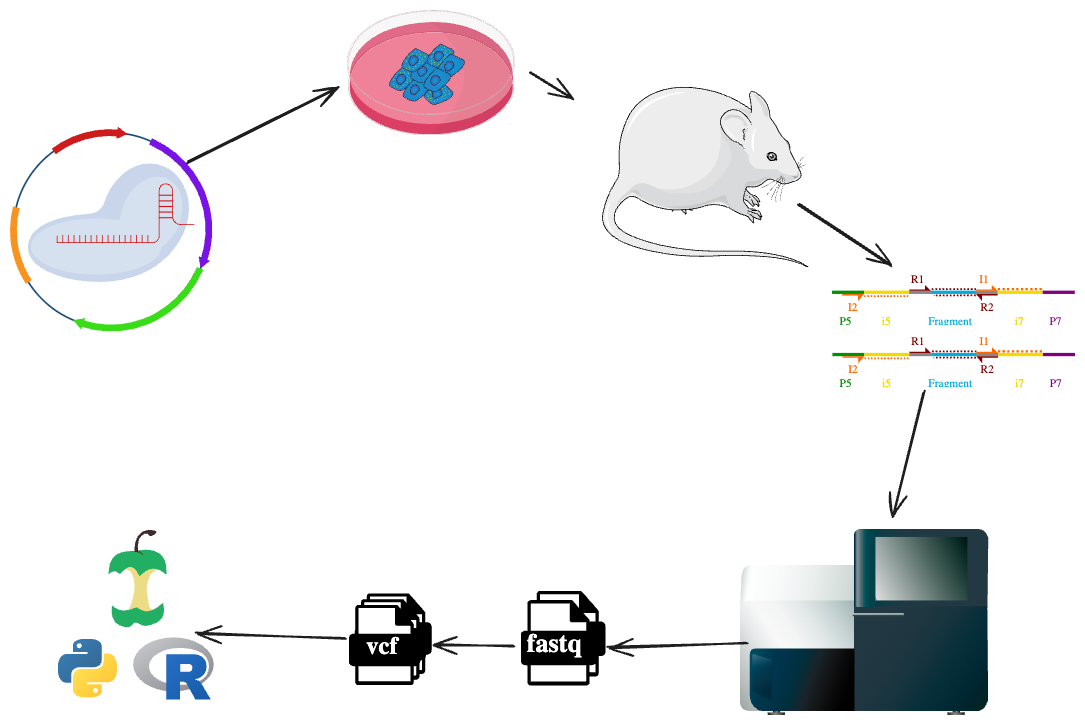
Bioicons is an open-source library of free scientific icons tailor-made for life sciences. Bioicons currently offers over 2,800 icons organized into about 30 categories: a crowd-sourced BioRender-like collection focused on small, schematic icons.
You’ll find icons for things like amino acids, lab instruments, DNA and protein structures, cell types (neuron, T-cell, etc.), organisms, and even technology tools (there are icons for machine learning, databases, computers, etc.). This breadth makes Bioicons especially handy for computational biology figures, where you might need a mix of biological symbols and tech icons (for example, a pipeline diagram that includes a DNA icon, a mouse icon, and a computer chip or cloud icon). All icons are available as SVG vectors. The style of icons can vary since multiple contributors are involved but generally they are simplified and monochromatic or limited in color, which makes them easy to adapt to your design. The platform also encourages contributions, so it’s continuously growing. Each icon’s page clearly notes its license and if attribution is needed. Most are CC0 (public domain) or MIT-style licenses that don’t require attribution.
Scidraw
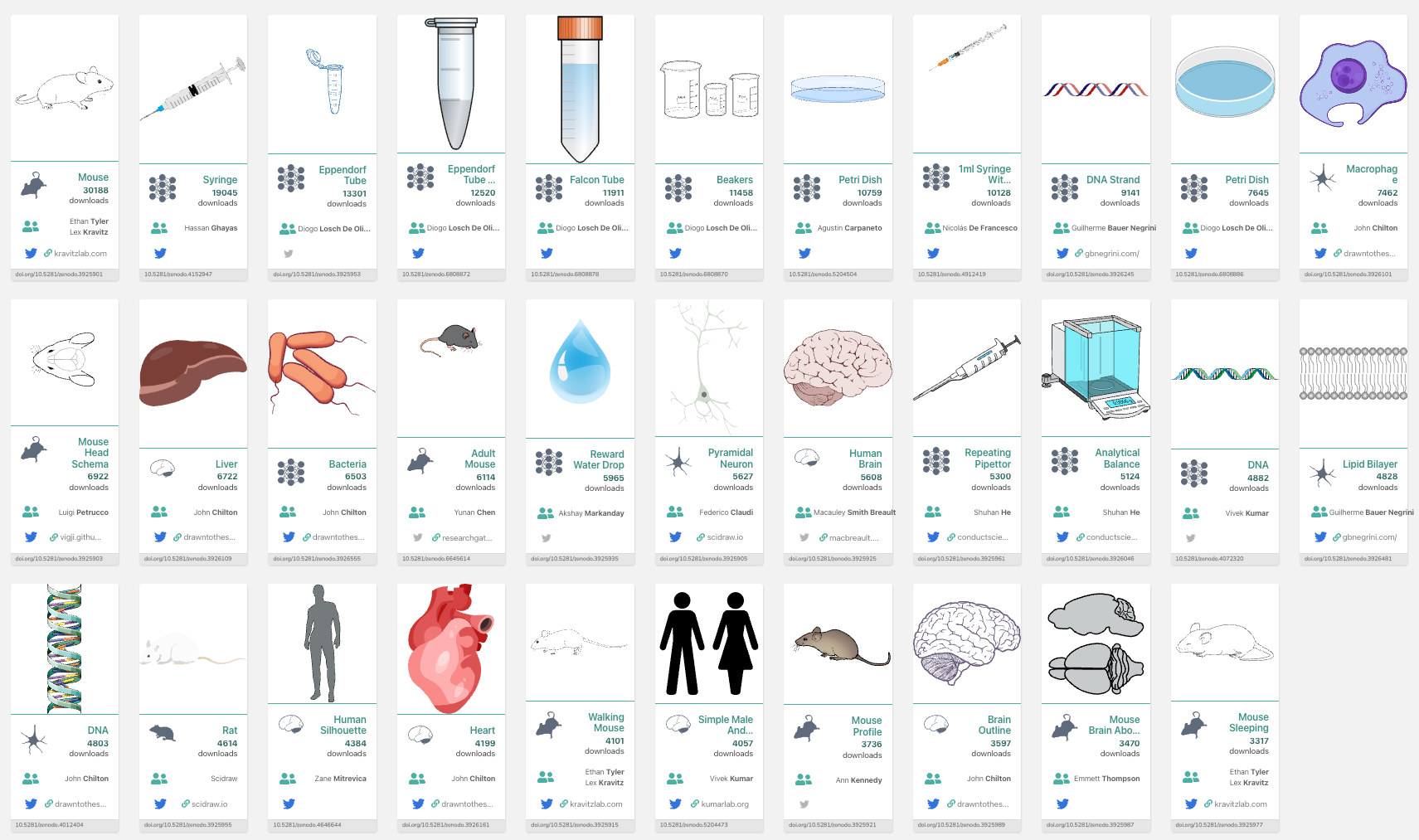
SciDraw (scidraw.io) is free repository of high quality drawings of animals, scientific setups, and anything that might be useful for scientific presentations and posters. It’s a community gallery of vector illustrations contributed by researchers and artists, covering a broad array of scientific subjects.
All content on SciDraw is available as high-quality vector graphics (SVG format). You can find illustrations of specific species (mice, fish, insects), anatomical drawings, lab apparatus (microscopes, pipettes, MRI machines), and schematic elements like graph axes or experimental layouts. Because contributors are often scientists, many drawings fill niche needs (e.g., a particular model organism in a certain pose, or a diagram of a behavioral experiment rig). Each drawing comes with metadata about the author and often a DOI, as SciDraw issues Zenodo DOIs for contributions. The site is searchable and browsable by tags, and you can download the images immediately (no login required). SciDraw also encourages anyone to submit drawings (there’s an approval process to ensure quality).
Open Science Art
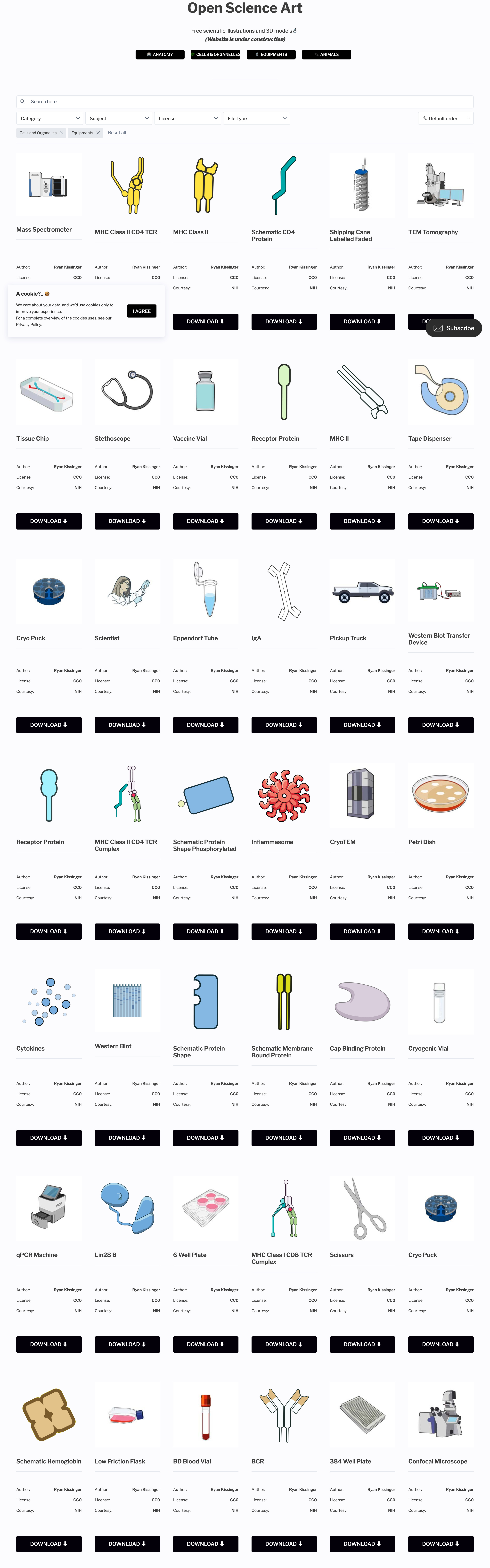
Open Science Art provides a large library of free icons, 3D models, and illustrations for science communication. You’ll find flat icons (similar to Bioicons or Health Icons style), detailed vector illustrations (like Servier or SciDraw content), and 3D molecular models or structures. Most 2D graphics are provided as SVG. The collection is curated but also open to submissions, and the site often notes the source of an item (e.g., “courtesy: NIH” if it pulled an image from NIH BioART. I think everything I’ve seen here is CC0 (public domain), so you can do whatever you want to with most images, without attribution.
Health Icons
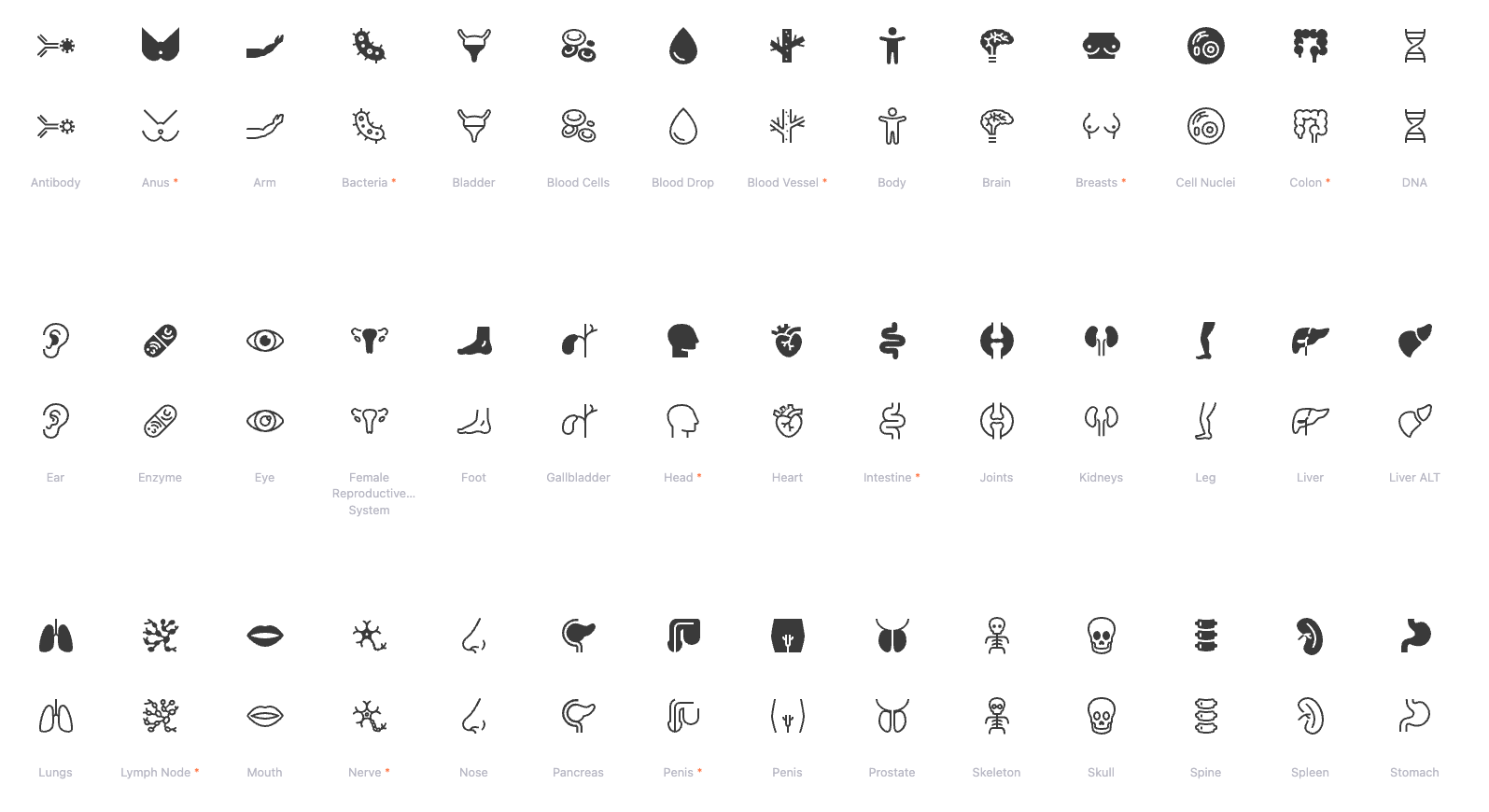
Health Icons is an open-source repository of simple health and medical icons spanning categories from anatomy and devices to symptoms and public health symbols. It offers a large collection (on the order of thousands) of clean, minimalist icons in both filled and outline styles, ideal for diagrams or infographics in biology and medicine. All icons are consistently styled (with options for SVG or PNG). You can grab individual icons or download the entire set at once. The entire collection is free, under a public domain (CC0) license. This means you can use the icons freely in personal or commercial projects, edit them, and redistribute, with no attribution required.
Servier Medical Art
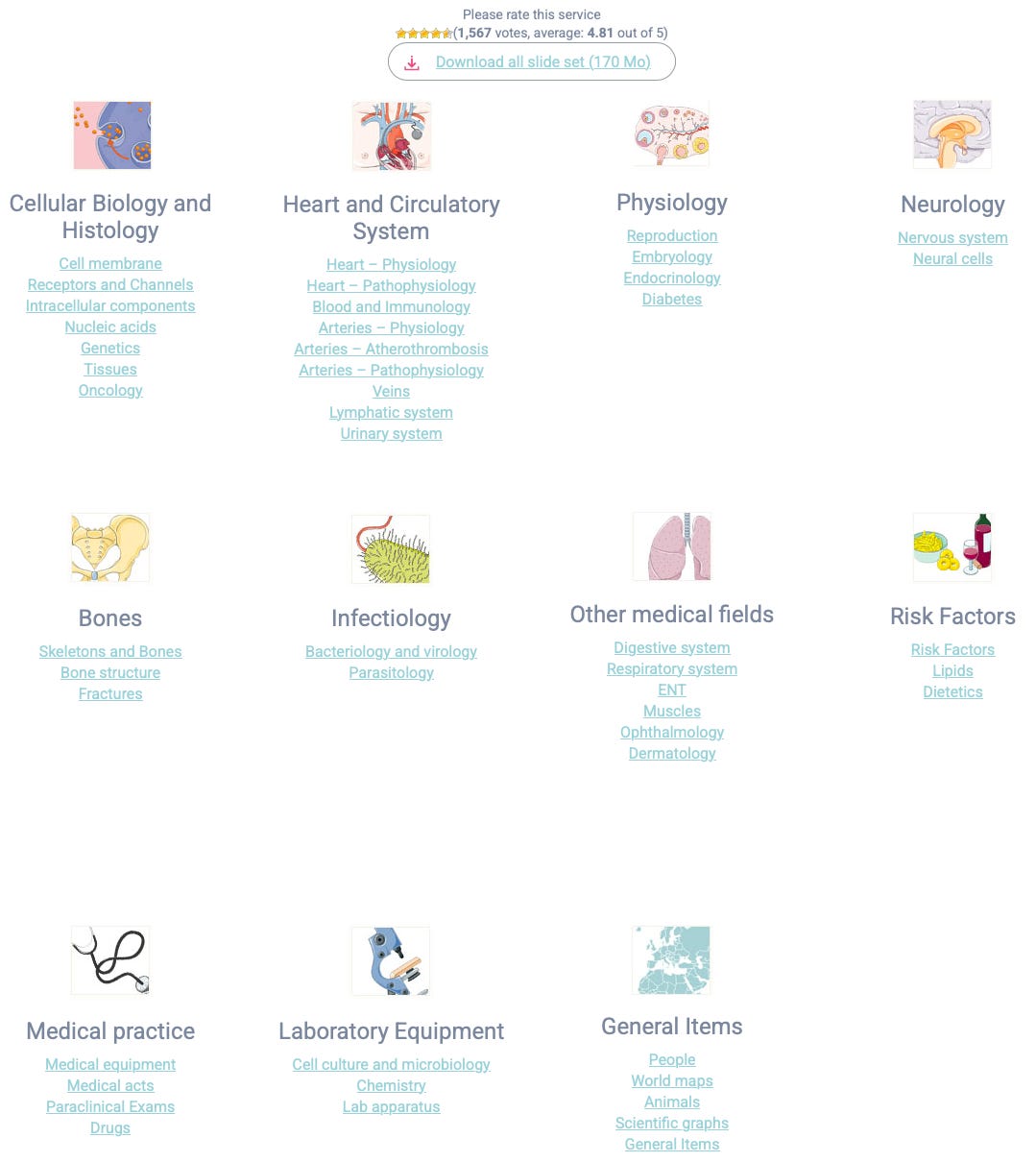
Servier Medical Art is a collection of medical and scientific illustrations provided by Les Laboratoires Servier, a French pharmaceutical company. This library contains over 3,000 high-quality vector images covering a broad range of topics in biology and medicine.
All images in the Servier collection have a consistent clean, semi-cartoon vector look with a limited color palette (often blues/greys), which makes it easy to mix and match them in a figure. You’ll find illustrations for human anatomy systems (nervous system, cardiovascular, digestive, etc.), cellular biology (signaling pathways, organelles), pharmacology (drug structures, medical devices), and even general science icons (people, animals, world maps, charts). The images are available as vector graphics. Servier offers its entire library as downloadable PowerPoint files by category, so you can open a PPTX and copy-paste or customize the vector art directly in PowerPoint or other drawing programs. They also provide PNG versions if you just need quick raster images.
All Servier Medical Art images are licensed under CC-BY: free to use and adapt for any purpose, as long as you give credit to Sevier. You can use the images commercially or modify them, provided the original source is credited. There’s no cost, no need to ask permission.
Biodiversity Heritage Library
The Biodiversity Heritage Library (BHL) is a digital library of historical life science literature. This one’s a bit different, but I love the old antique images available here. Their Flickr account hosts over 300,000 biodiversity illustrations including classic drawings and paintings of animals, plants, insects, etc., scanned from antique books and journals. As of this writing there are over 300,000 images available. Most are free of copyright restrictions (public domain) since the source publications are often from the 1800s or 1900s, with most images able to be downloaded, shared, reused, or transformed freely.
The images are usually scanned plates or figures from 18th, 19th, and early 20th century publications on natural history. You’ll find everything from beautifully detailed bird and botany plates, to diagrams from old scientific manuscripts. The images are organized into albums by the source book or by taxonomy. The aesthetic is different from modern schematic icons: these are artistic, sometimes colorful, sometimes etchings or woodcuts.
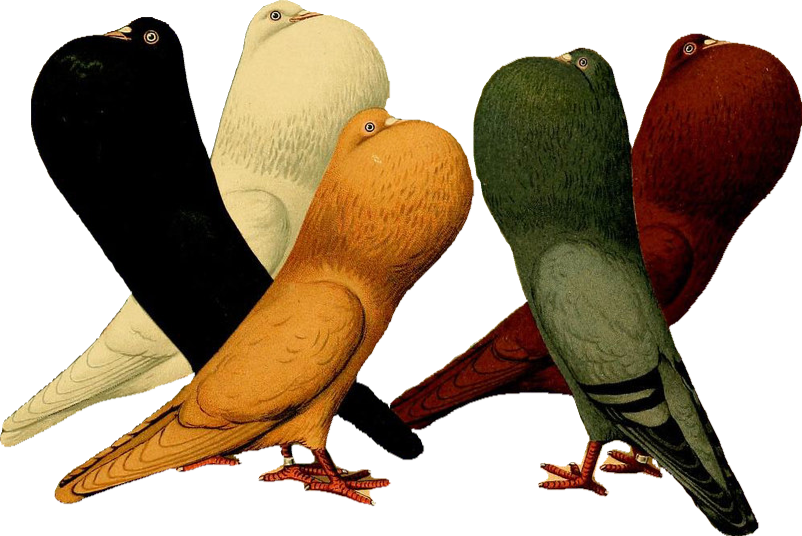
Something jumped out at me about these majestic pigeons from the early 1900s. I ran this image through Segment Anything (see below) to cut the birds out of the background.
The Noun Project
The Noun Project is an honorable mention here. There are over 7 million free(-ish) icons available in either PNG or SVG. You can use any of them for free, but you have to pay if you want to use them royalty-free for commercial purposes, and pay yet more if you want to download entire icon sets at once, or make derivatives of the icons they provide.
Tools
Segment Anything
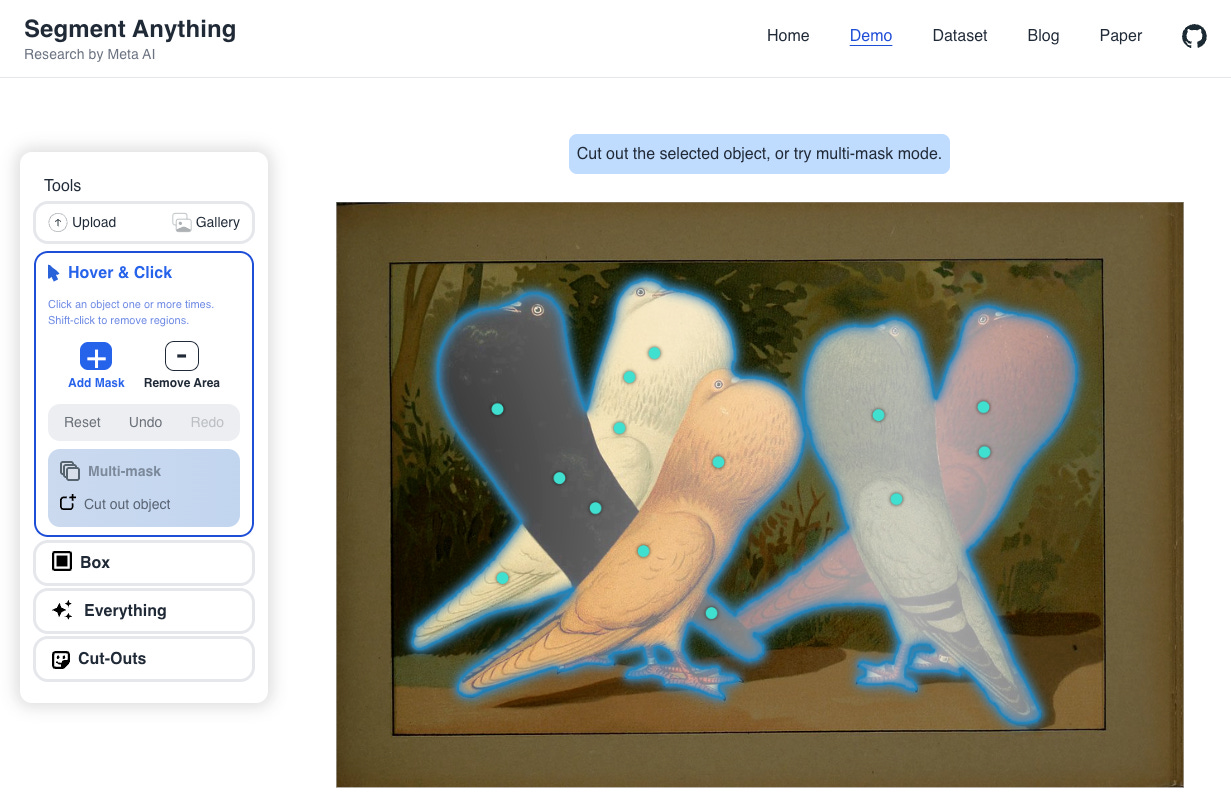
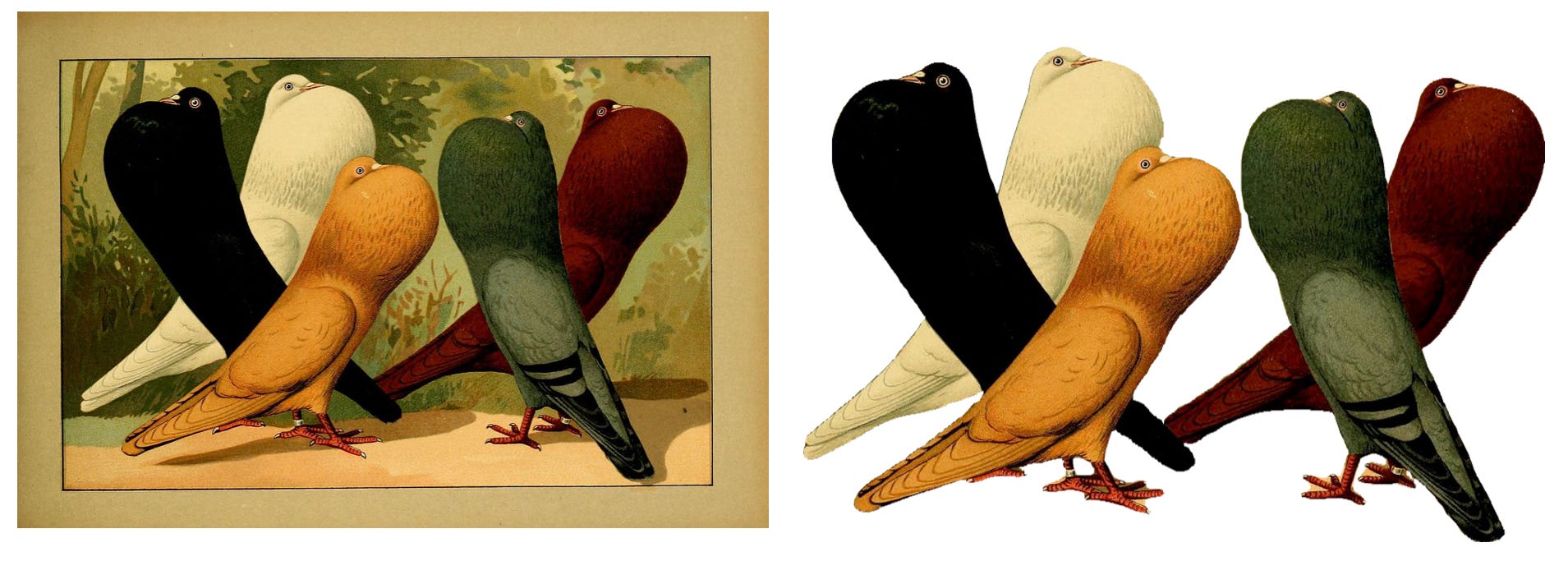
Image segmentation is a computer vision technique that partitions an image into different regions or segments based on pixel characteristics. I use Meta’s original Segment Anything web tool to do this (blog post; paper). You upload an image, place a few dots around the parts of the image you wish to cut out, and that’s really it. You get a PNG with a transparent background of the region you cut out. Here’s what it looks like segmenting those majestic pigeons from the photo above.
And here’s the before and after.
Excalidraw and other diagramming tools
I wrote about Excalidraw, my favorite diagramming tool here previously:

Before Excalidraw I used draw.io, and before that I used LucidChart, and before that I used Microsoft Visio. Excalidraw runs completely in your browser, has VS Code integration, is end-to-end encrypted, has sharing/collaborative functionality, and has mermaid-to-diagram and AI-based description-to-diagram functionality. I actually like the default scrappy hand-drawn look of Excalidraw, but you can easily turn the scrappiness off and use a standard serif / sans serif font if you choose.
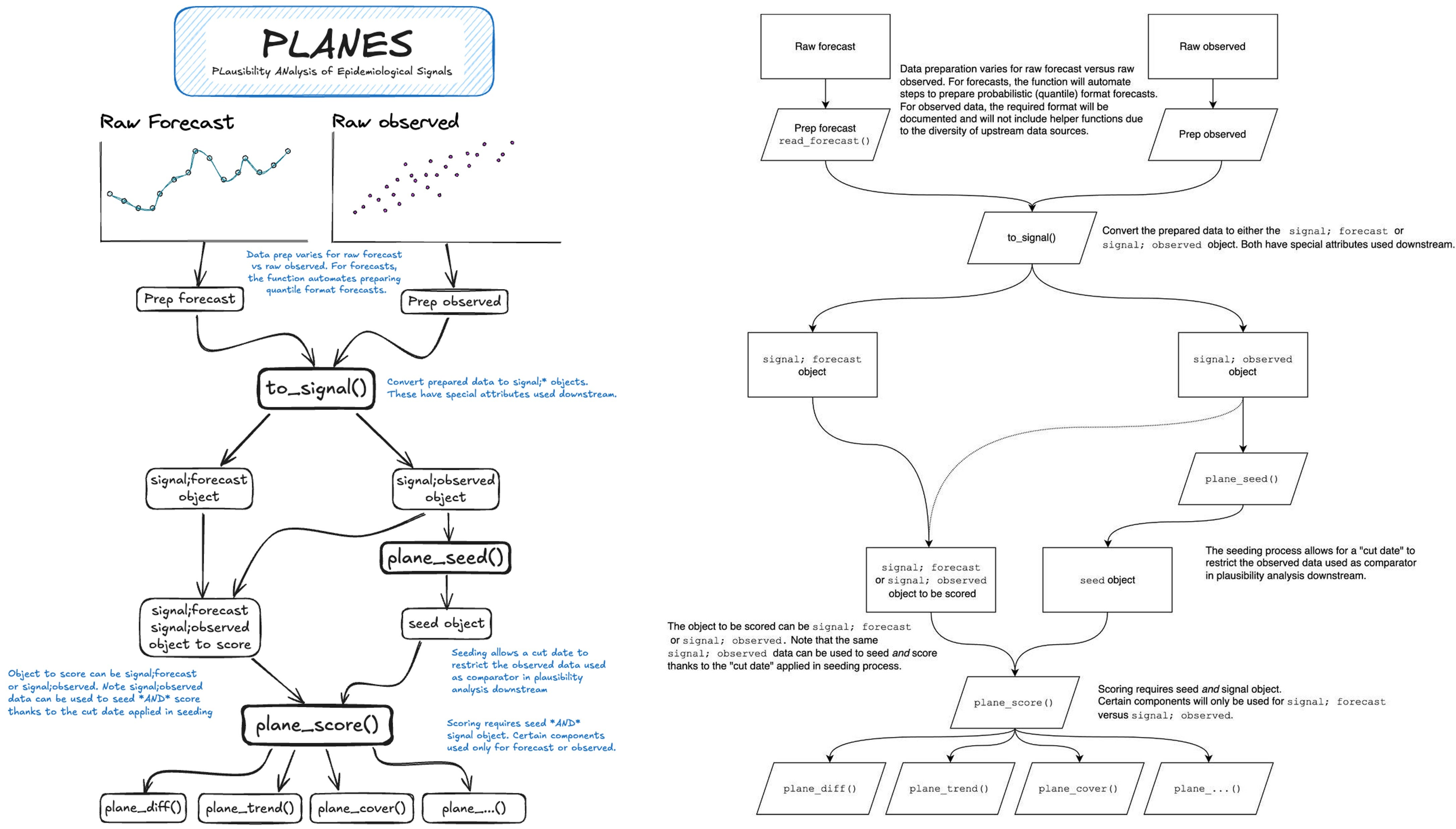
Alternatively, draw.io (a.k.a. diagrams.net) gives you a little bit more control over your diagrams. Below is an Excalidraw version (left) of the original version of Figure 1 of the PLANES paper made with draw.io.
Honorable mention: Biographics
Honorable mention here, because this neither completely free nor open-source, but the free tier covers a lot of what you’d want. My colleague Nishant Jha recently dropped by my office to show me something he’s been working on. Biographics (biographics.nitro.bio) is a scientific figure building tool that combines:
Several of the image resources above (BioArt, BioIcons, etc)
Drawn on an excalidraw canvas
With some AI agent help for drawing your own
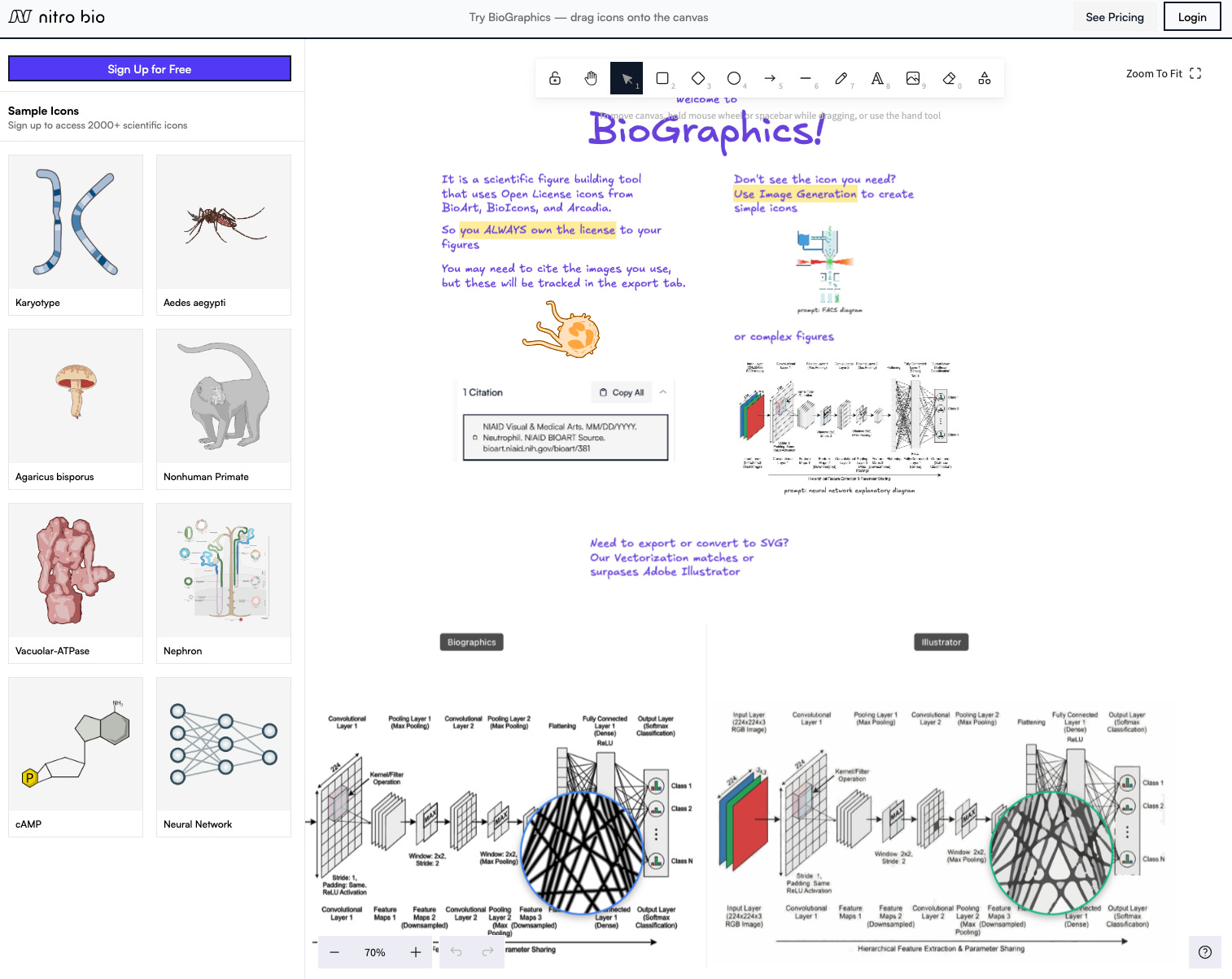
You can use the tool for free to generate simple diagrams in an Excalidraw canvas pulling in openly licensed images. But Biographics also has a few nice AI features. First, the plot agent, which allows you to drop in a plot and it recreates them as interactive matplotlib plots.
And second, the built-in agent to manipulate or completely generate a figure. Here I’m asking it to create a figure explaining an RNA-seq experiment. It drops in some placeholders that I’d need to go back and add graphics to later, but it’s a great start.
You could get passable images out of Nano Banana or ChatGPT, but those outputs aren’t editable. Biographics gives you an Excalidraw canvas you can keep working on. Worth a look at biographics.nitro.bio.
These are great! For people needing editorial photography or prints, I find the following useful:
* NIH Images from the History of Medicine Collection: https://www.nlm.nih.gov/hmd/collections/photos.html
* Public Domain Review's Image Archive: https://pdimagearchive.org/galleries/themes/science-and-medicine/
* The Flickr Commons: https://flickr.com/commons
* Wikimedia Commons: https://commons.wikimedia.org/wiki/Main_Page
(note: the latter two are often under CC licenses that require attribution, whereas the first two contain public domain images are free to use without attribution)
These are great. Thank you so much!