
GPT-5.6 came out yesterday. Plenty of other people are writing about it. I’m not yet, because I’m trying to be intentional about my AI use in July (it’s not going great — AI Dry July is more like an AI-damp-kinda-moist July). But, I was able to get a correct one-shot answer to something many smart people I know get consistently wrong, despite all the evidence widely available.
Another six things this week. Stretching to find a common theme here: each of them touch on knowledge in some way or another:
Anthropic and AE Studio’s GRAM, and why removing knowledge from weights isn’t the same as removing risk.
PhD admissions down, and what funding uncertainty does to a cohort.
A Brown economics class where the take-home midterm averaged near 100% and the in-person final averaged below 50%.
Watching long form reading erode (keep reading 😉)
AI labs becoming biotech firms.
SecureBio on the “Bio Mythos” moment, and building biosecurity assurance.
And a note, with a very special thanks to my paid subscribers (remember, every post here is free and open, regardless of whether you pay): These kinds of recap posts take a lot of time and energy to write. And exceptionally so while avoiding AI for discovery, scanning, summarizing, triage. I also have a major, very major proposal deadline at the end of this month. While I have a few other essays I’ll be publishing soon, you won’t see another recap like this for a while. Follow some of the other Newsletters I recommend to keep you caught up.
1. An off switch*
Anthropic and AE Studio published a method this week for giving a model a removable compartment per category of dual use knowledge.
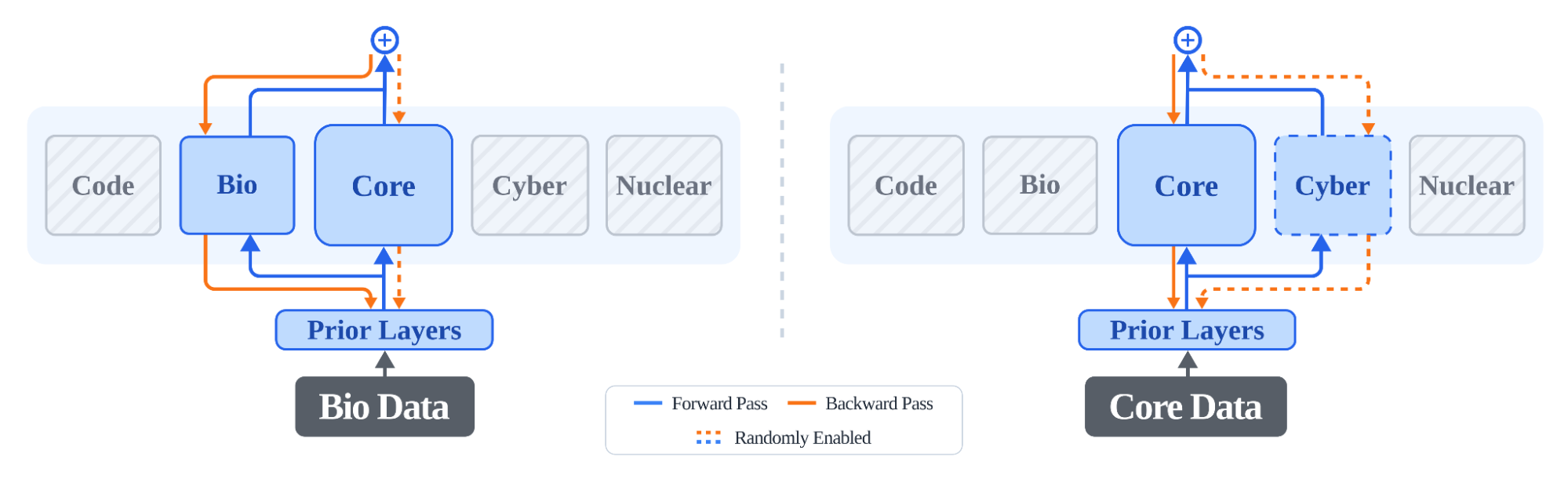
They call it GRAM, for Gradient-Routed Auxiliary Modules: add extra neurons to every layer, route the gradient updates from virology or cybersecurity or nuclear physics text into that category’s module during pretraining, then delete the module at inference when you don’t want the capability. One training run yields a model you can reconfigure many ways across domains instead of training many filtered models.
They compared with post-hoc unlearning. When they tried to fine tune a removed capability back in, the unlearning baseline (MaxEnt) recovered almost fully, while GRAM and plain data filtering held. Unlearning after the fact suppresses more than it removes.
* = The asterisks: everything is measured in next token loss and not actual downstream performance, the dual use data was a sliver of the mix, nothing has touched a production Claude model, and some capabilities may be
so entangled with general knowledge that no method can separate them cleanly.
Really cool work here but important to pair this with a well-designed uplift study, and better yet, measuring correlates of uplift. Lower next token loss on virology tokens isn’t the quantity that most people (policymakers, biosecurity folks, general public) care about. Uplift is: can someone holding the ablated model do the dangerous thing any less well than someone with a search engine? So model editing and unlearning work needs paired human uplift studies, same models, capability toggled on and off, measured against a real baseline. Removal that looks clean in loss space but buys no drop in uplift might look like safety but isn’t.
2. Planting an orchard
NYT / Vimal Patel: Decline of Ph.D. Admissions Could Imperil a ‘Generation of New Talent’ Gift Link.
PhD admissions this fall dropped 15% from last year across 55 Association of American Universities members, per the AAU Data Exchange. Those schools confer about half the country’s research doctorates. This all stacks on last years numbers: for the 42 schools that reported fall 2025, new enrollments were already down. I.e., Two straight years of contraction at the institutions that produce most of the nation’s new scientists.
…developing research talent “is more like planting an orchard than filling a warehouse.”
Some are far worse than the average. MIT expects nearly 20% fewer new graduate students, about 500 people, citing federal awards down 20% and the new endowment tax. Caltech is cutting new graduate admissions 40% across the board for fall 2026, and its graduate dean was explicit that the driver is a lack of funding certainty, not any specific cut. UW’s astronomy chair took zero new doctoral students this year, the first time since 2016.
I look at this with research dean hat on. You need students to drive research. The cohort you don’t admit this year doesn’t come back when the budget stabilizes.
3. “We cannot choose to become idiots”
IHE / Emma Whitford: Brown Professor Suspects Majority of His Class Used AI to Cheat. https://www.insidehighered.com/news/faculty/learning-assessment/2026/07/08/brown-professor-suspects-most-his-class-used-ai-cheat
Roberto Serrano, who has taught welfare economics at Brown for nearly 20 years, gave a take home midterm for the first time this spring, partly because students were uneasy in a classroom after the December shooting on campus. The class, normally around 30, had 86. The midterm averaged 96% against a historical 65-to-80 range, on an exam he’d made harder. He ran the questions through ChatGPT, got answers matching his students’ work down to the same overcomplicated proof strategy, and told the class he suspected widespread AI use. He moved the final in-person.
18 people dropped, 9 skipped the final altogether, and of those who sat it the average was 48%, the lowest he’s recorded, against a prior floor of 65. 19 failed.
A 96% to 48% collapse between take home and proctored is strong circumstantial evidence the take home scores weren’t the students’ own work. It isn’t proof about any individual. Brown’s academic code committee wants separate complaints per student with exam copies. AI detectors would throw false positives and negatives in bulk. The committee’s own AI report, out the same week, recommends de-emphasizing punishment. His own summary was blunter:
We cannot choose to become idiots.
4. The end of reading, again
Atlantic / Rose Horowitch: The End of Reading Is Here. https://www.theatlantic.com/magazine/2026/08/reading-crisis-postliterate-age/687618/
The Atlantic’s August cover essay, by Rose Horowitch, argues America has gone postliterate: not illiterate, but losing the higher order comprehension sustained reading builds. Fewer than half of adults read a book of any kind in 2022. Reading for pleasure on a given day fell from 28% in 2004 to 16 in 2023, and gambling has passed reading as a leisure activity. Text now thrives inside a shrinking minority, about 20% of adults accounting for more than 80% of books read.
What are you reading now? Last week I finished re-reading Andy Weir’s Project Hail Mary (the encore was just as good). I just started reading Stewart Brand’s Maintenance of Everything, while listening to David Sedaris’s newest collection of essays, The Land and Its People (read by him).
5. A biotech startup now?
5a. Claude Science and drug discovery
Jesse Johnson at Scaling Biotech on Anthropic’s early-July drug-discovery announcements: Claude Science (which I test-drove here) and an internal effort to find candidates for rare and orphan diseases. His read is that it backfires commercially. Tokens are expensive, open weight models are closing the gap, and
the whole point of it is to make you use Anthropic’s models
instead of self hosting, so it has to stay pricey. Worse, an in-house drug discovery team reads to pharma customers as a future competitor trained on their data, however carefully the rare disease problem is chosen.
5b. Nature Biotech commentary
Related, Amelia Palermo’s Nature Biotechnology comment provides some structural context.
Palermo, A. Frontier AI companies as biotech acquirers. Nat Biotechnol (2026). https://doi.org/10.1038/s41587-026-03214-0
In April, Anthropic acquired Coefficient Bio for about $400 million (all stock): roughly 8 months old, <10 computational biologists, no clinical assets. Against a $380B valuation that’s about 0.1% dilution. In other words it’s a standard tech exit rather than a typical pharma one, with a value Palermo calls
a purchase of foundation model talent and code base.
She sees a new class of buyer, frontier labs acquiring biology platforms for models, data, and people instead of drugs, and predicts several such deals by 2030.
5c. Job ads
I just took a look at some of the job ads, which point to how serious these companies seem. Anthropic isn’t only reselling Claude to pharma. Looks like they’re building a wet lab, hiring bench scientists and the people to run it:
OpenAI’s public bio hiring leans the a different direction, toward safety, policy, and red teaming. Which is near and dear to my heart. I can’t wait to see what this team does here.
Most of these listings are in the $300k-400k range, plus equity.
6. Before the Bio Mythos moment
Governments tend to react to AI risk only after a surprise, and Claude Mythos was the cyber case: its ability to find and exploit weaknesses in critical infrastructure software pushed cyber capability to the top of the agenda, and the Fable takedown (reportedly 90 minutes for Anthropic to bar foreign access before it pulled the model worldwide) showed how little assurance infrastructure exists to make those calls deliberately. The controls have since been lifted, though Commerce keeps the right to reimpose them. The argument is that a “Bio Mythos” moment, a model crossing into dangerous biological capability, would trigger the same improvisation in a domain where the danger is harder to measure and, in their words,
self-replicating, offense-dominant, and can have enormous societal ramifications.
Their fix is to build the assurance infrastructure before that moment: independent evaluators with real model access and a liability safe harbor, standardized capability tests like their BioTIER, and a default against exposing advanced bio capabilities to unverified users.
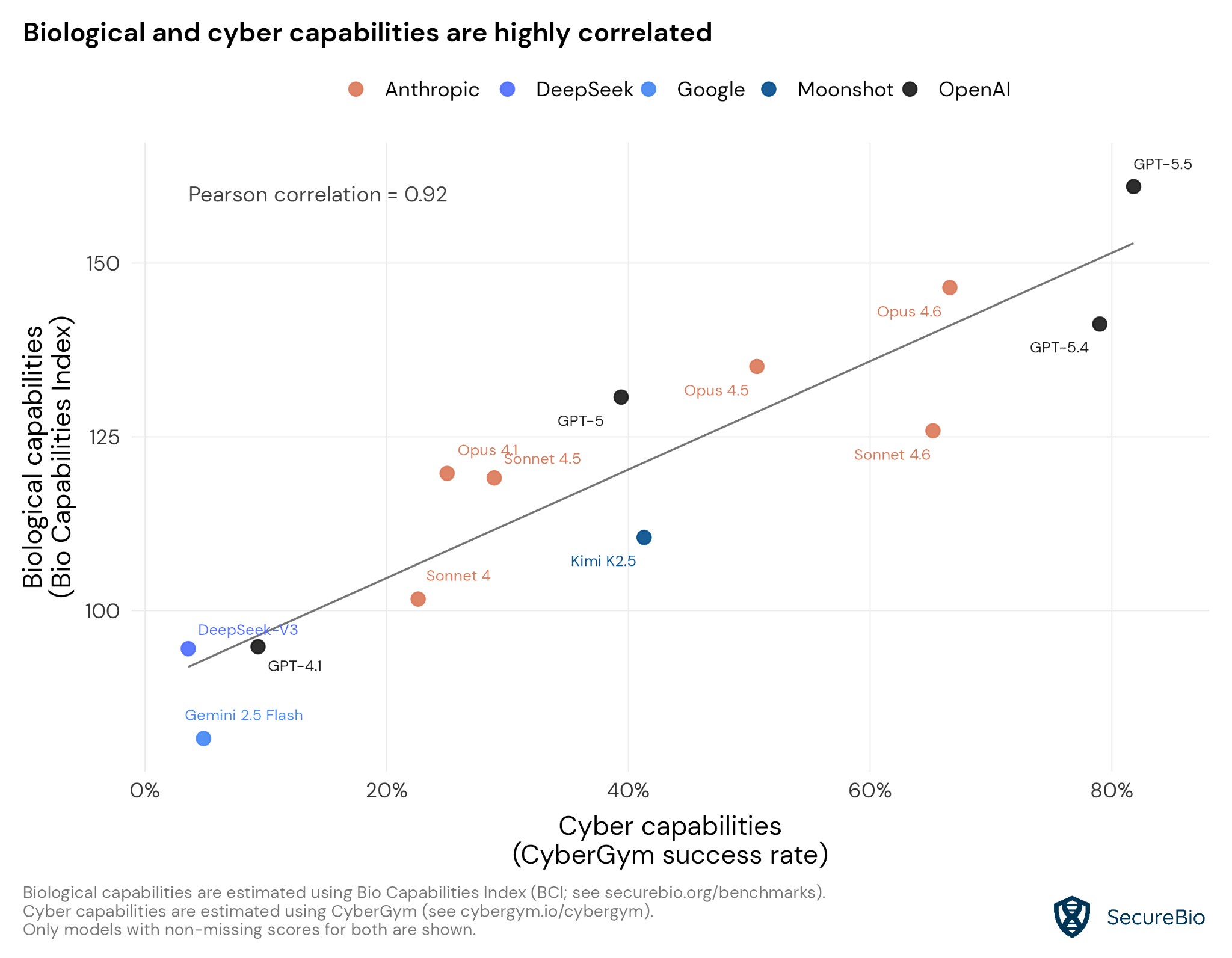
Their Bio Capabilities Index shows the trend rising even as newer models add refusals. This is the missing half of the GRAM story in #1 above: you can build an off switch, but someone has to decide when to flip it, and that call needs more than a back channel phone call (maybe more well designed uplift studies, and better yet, measuring correlates of uplift). For my fellow Virginia readers, the state’s 2026 legislation already directed its technology commission to study an independent verification framework.