
The convergence1 of artificial intelligence and biotechnology (AIxBio) is no longer a futuristic concept. It’s a rapidly unfolding reality that is redefining the boundaries of medicine, agriculture, and national security. The new book Biotechnology and AI: Technological Convergence and Information Hazards, edited by Christopher L. Cummings, Benjamin D. Trump, and others, is chock full of chapters that explore this frontier. Part of the NATO Science for Peace and Security (SPS) Series, this volume is the culmination of a high-level Advanced Research Workshop (ARW), where international experts gathered to address the dual-use nature of these emerging technologies.
I’ve been making my way through these book chapters in the sauna2, and I’ll summarize what I’m reading over a few posts.
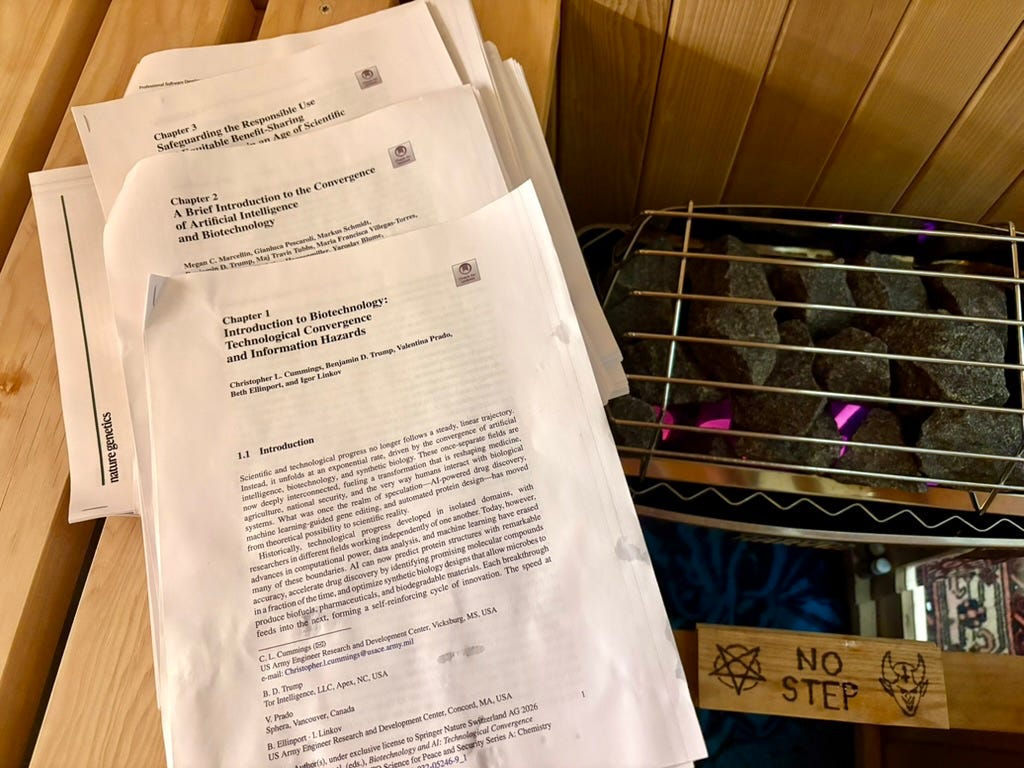
Overall, throughout the volume, a clear set of overarching themes emerges that bridges the gap between scientific innovation and global safety. Central to these discussions is the “pacing problem,” the phenomenon where the speed of technological development far outstrips the ability of traditional regulatory frameworks to govern them (speaking of regulation, if you haven’t yet read Alexander Titus’s essay on the Science of Responsible Innovation, you should).
The authors of these book chapters collectively grapple with the concept of information hazards, analyzing how the democratization of powerful AI-driven biological tools increases the risk that sensitive data or computational models could be misused. By balancing the need for scientific openness with the imperatives of biosecurity, this collection provides a roadmap for adaptive governance in an era where biology is becoming a digital, and potentially programmable, discipline.
Below is a summary of the first few chapters. Part 2 coming next week.
Introduction to Biotechnology: Technological Convergence and Information Hazards.
Cummings, C. L., Trump, B. D., Prado, V., Ellinport, B., & Linkov, I. (2026). Introduction to Biotechnology: Technological Convergence and Information Hazards. In C. L. Cummings, B. D. Trump, V. Prado, B. Ellinport, & I. Linkov (Eds.), Biotechnology and AI: Technological Convergence and Information Hazards (pp. 1–10). Springer Nature Switzerland. https://doi.org/10.1007/978-3-032-05246-9_1
This chapter explores how the rapid fusion of artificial intelligence and biotechnology is transforming medicine and agriculture while creating a significant regulatory gap known as the pacing problem. The authors argue for a shift toward adaptive, flexible governance models that can keep pace with democratized scientific tools and the inherent unpredictability of AI-driven research.
It’s a really good complement to Alexander Titus’s essay I mentioned above, which I highly recommend reading if you haven’t already.

A Brief Introduction to the Convergence of Artificial Intelligence and Biotechnology
Marcellin, M. C., Pescaroli, G., Schmidt, M., Trump, B. D., Tubbs, M. T., Villegas-Torres, M. F., Lambert, J. H., Haggenmiller, C., Blume, Y., Kamrud, A., & Linkov, I. (2026). A Brief Introduction to the Convergence of Artificial Intelligence and Biotechnology. In C. L. Cummings, B. D. Trump, V. Prado, B. Ellinport, & I. Linkov (Eds.), Biotechnology and AI: Technological Convergence and Information Hazards (pp. 11–55). Springer Nature Switzerland. https://doi.org/10.1007/978-3-032-05246-9_2
This chapter provides an overview of the technical synergy between artificial intelligence and biotechnology, emphasizing how machine-driven analysis is unlocking new scientific frontiers. It stresses the importance of capability-based governance and periodic reassessment to manage the complex uncertainties and functional impacts of this technological merger.
Safeguarding the Responsible Use and Equitable Benefit-Sharing of Biotechnology in an Age of Scientific Modernization
Novossiolova, T., Ellinport, B., Vindman, C., Binz, T., Jarman, H., Myers, C. J., Natsvlishvili, M., & Rojas, M. J. R. (2026). Safeguarding the Responsible Use and Equitable Benefit-Sharing of Biotechnology in an Age of Scientific Modernization. In C. L. Cummings, B. D. Trump, V. Prado, B. Ellinport, & I. Linkov (Eds.), Biotechnology and AI: Technological Convergence and Information Hazards (pp. 57–73). Springer Nature Switzerland. https://doi.org/10.1007/978-3-032-05246-9_3
This chapter addresses the ethical imperative of ensuring that the benefits of biotechnological progress are shared equitably across global populations while maintaining rigorous safety standards. It explores updated frameworks designed to protect against exploitation and foster international cooperation in the development of modern biological tools.
Information Hazards and Biotechnology
Braun, N., Epstein, G. L., Esvelt, K., Knutsson, R., Montague, M. G., Oye, K. A., Rusu, A.-G., Vizzotti, L., & Yemets, A. (2026). Information Hazards and Biotechnology. In C. L. Cummings, B. D. Trump, V. Prado, B. Ellinport, & I. Linkov (Eds.), Biotechnology and AI: Technological Convergence and Information Hazards (pp. 75–88). Springer Nature Switzerland. https://doi.org/10.1007/978-3-032-05246-9_4
The authors define information hazards as risks stemming from the dissemination of biological data or computational models that could be misused for harmful purposes. The chapter evaluates strategies for balancing scientific openness with the security requirements of a dual-use technological landscape to prevent unintended consequences.
Biotechnological Convergence: Implications for Regulatory Divergence and Bioeconomic Development
Trump, B. D., Wu, F., & Cummings, C. L. (2026). Risk Culture in a Time of Biotechnological Convergence: Implications for Regulatory Divergence and Bioeconomic Development. In C. L. Cummings, B. D. Trump, V. Prado, B. Ellinport, & I. Linkov (Eds.), Biotechnology and AI: Technological Convergence and Information Hazards (pp. 89–108). Springer Nature Switzerland. https://doi.org/10.1007/978-3-032-05246-9_5
This chapter examines how different societal attitudes toward risk lead to divergent regulatory paths for biotechnology across various international regions. It analyzes how these cultural differences impact bioeconomic competitiveness and the ability of nations to coordinate on global security standards.
The second chapter defines convergence. “Convergence represents a fundamental paradigm shift in scientific and technological development—moving beyond interdisciplinary collaboration toward the deep integration of previously distinct fields to create novel capabilities and insights. While interdisciplinary research brings together multiple disciplines to address common problems while maintaining distinct methodological approaches, convergence creates new conceptual frameworks and methodologies at the intersection of fields.” I also liked the section in the first chapter talking about the bidirectional nature of this convergence: “A defining characteristic of AI and biotechnology convergence is the bidirectional exchange of concepts and design principles between the two disciplines. Neural networks, drawing inspiration from biological systems, exemplify this change. Properties of biological systems (the human brain, in the case of neural networks) influence the design of algorithms that navigate complex problems within stochastic environments, while AI simultaneously enhances our ability to engineer biological systems with unprecedented precision.”
I built a sauna in my house last year and use it every day. I learned the hard way that the glue on book bindings melts at 195F. Electronics are out of the question. Because I’m limited to stapled print-outs, it’s the perfect distraction-free zone to catch up on papers.