
Scientists at Shanghai Jiao Tong University in Shanghai built AutoDNA, a lab where AI agents turn natural language requests into molecular biology experiments.
Wu, M., et al. An AI-native experimental laboratory for autonomous biomolecular operations. Nature (2026) 10.1038/s41586-026-11228-6 (gift link).
The agents plan the work and coordinate lab instrumentation to carry it out. Demos included optimizing DNA synthesis, and storing a digital message in DNA then sequencing it to recover the message. Really interesting paper. I’d love to personally see this in action.
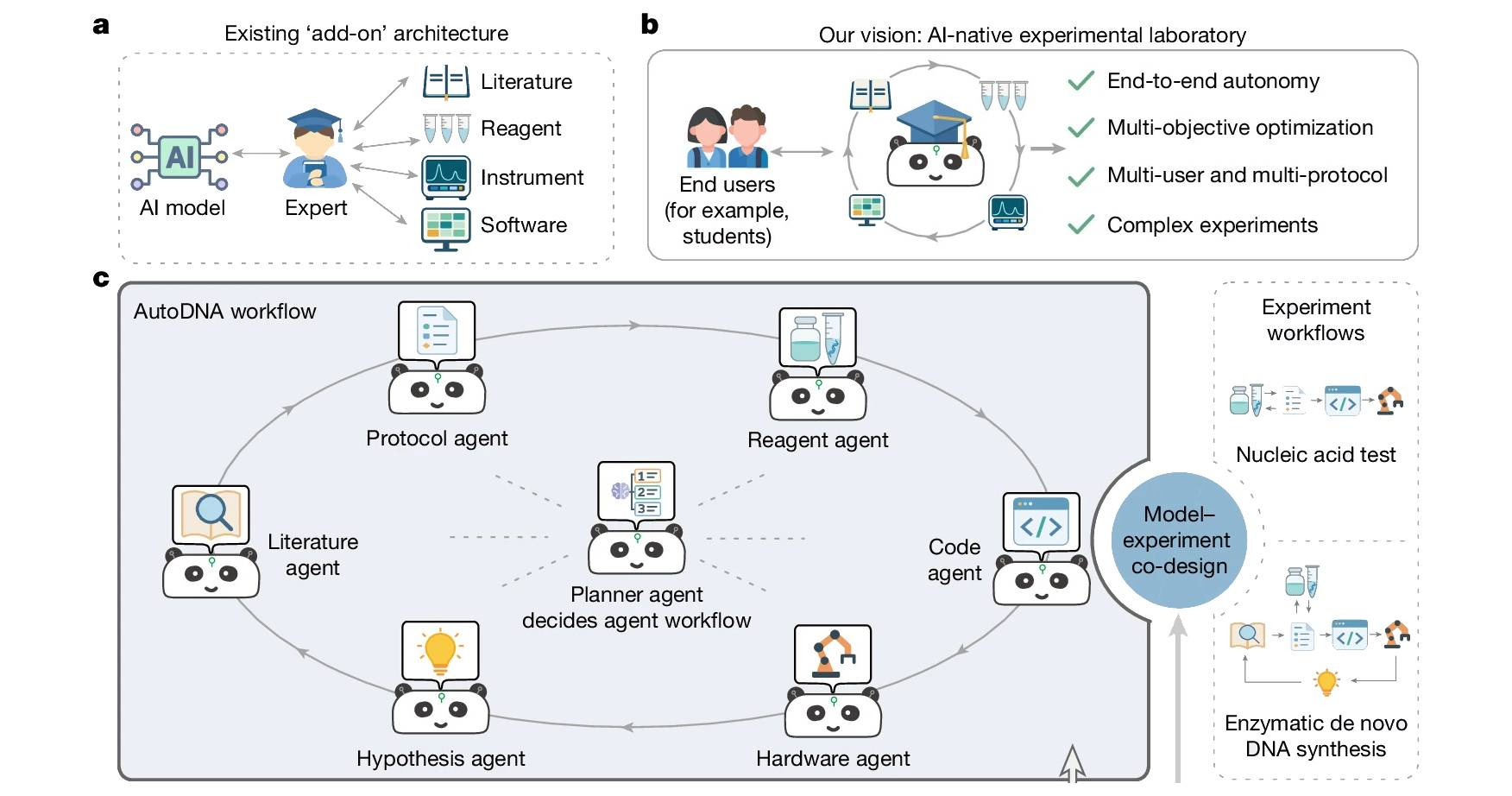
Automated labs can reduce the practical expertise and tacit knowledge its users need to carry out experiments. Human expertise still supports the AutoDNA system, even when the person requesting an experiment doesn’t actually supply that expertise. This could broaden access to useful research but it also lowers barriers to work that poses biological risks.
In-the-flesh humans built and configured this lab. They prepared reagents, and they replenished supplies. A few equipment failures required human help. The methods section of the paper describes human interpretation of some results. The demos covered nucleic acid experiments only, without manipulating cells or animal models. The paper doesn’t establish that novices can perform dangerous biological work, and it doesn’t quantify how much assistance they might gain.
In Heidi Ledford’s reporting on the study, synthetic biologist Julius Lucks questions whether AutoDNA has enough human oversight.
“You set up this operation, and then you’re not in the loop. You can’t keep track of it,” he says. “It’s really important to have the human in the loop.”
Co-author Haibo Chen responds:
Chen says that the lab would need a dedicated biosafety and biosecurity plan with additional guardrails, including explicit human-authorization steps, and the ability to monitor and pause experiments in progress.
James Zou’s accompanying commentary distinguishes operational safety from biosecurity.
Operational safety is not the same as biosecurity. As autonomous labs become more accessible to users, a key safeguard is to screen proposed experiments before they are conducted.
AutoDNA checks generated instrument code in a simulation before execution. That might catch mistakes like trying to take a measurement before putting the sample in the instrument. These kinds of checks address execution errors, but screening for biological misuse needs a separate assessment of the proposed work.
This would mean screening experiments before execution, implementing reasonable access controls, and keeping good records of who authorized the work.1 Biosecurity evals should test what users can do with access to the complete system, including whether screening actually detects and properly classifies risky or prohibited experiments before they’re run. This would require tests where agents can take actions beyond just generating text.2
I made some of the same arguments in a TV interview I did a few months ago.
See the excellent work RAND is publishing on this topic: (1) Barkan et al. Restricting AI Agent Use of Biological Tools: Exploring the Feasibility of Software Barriers. 2026. https://www.rand.org/pubs/research_reports/RRA5000-1.html; (2) Lee et al. Testing Large Language Model Agents on the Use of Biological Tools for Nucleic Acid Synthesis Screening Evasion. 2026. https://www.rand.org/pubs/research_reports/RRA4741-2.html; (3) Paskov et al. Measuring Biological Capabilities and Risks of AI Agents: Generating and Interpreting Evidence from Agentic Evaluations. 2026. https://www.rand.org/pubs/perspectives/PEA4710-1.html.