
There’s a funny thing that happens to me from time to time. I randomly stumble across an essay or a paper that resonates with me, sometimes one that I can’t stop thinking about for days. Then I come to find out the author is a colleague here at my own University of Virginia in the building next door who I never knew of.
Daniel Willingham is a professor of psychology here at UVA (I don’t know him, but hope to meet you soon, Dan, and compare notes). I just came across an essay Dan published back in August. It’s good, and you should take the <5 minutes to read it in full. Even if you’re not an educator, you probably still have junior folks working for you or may be doing some on-the-job training, and Dan’s points are still relevant, so substitute whatever you want for “students” in your case.

His argument is that students should only use AI for the things they already know how to do well. Not brainstorm-with-AI-but-draft-yourself vibes, and not summarize-with-AI-but-write-the-essay-or-whatever-yourself vibes, which are what a lot of AI “policies” look like in higher ed, and even K-12. E.g., here are the policies from our own Albemarle County Public Schools around us here in Charlottesville Virginia:
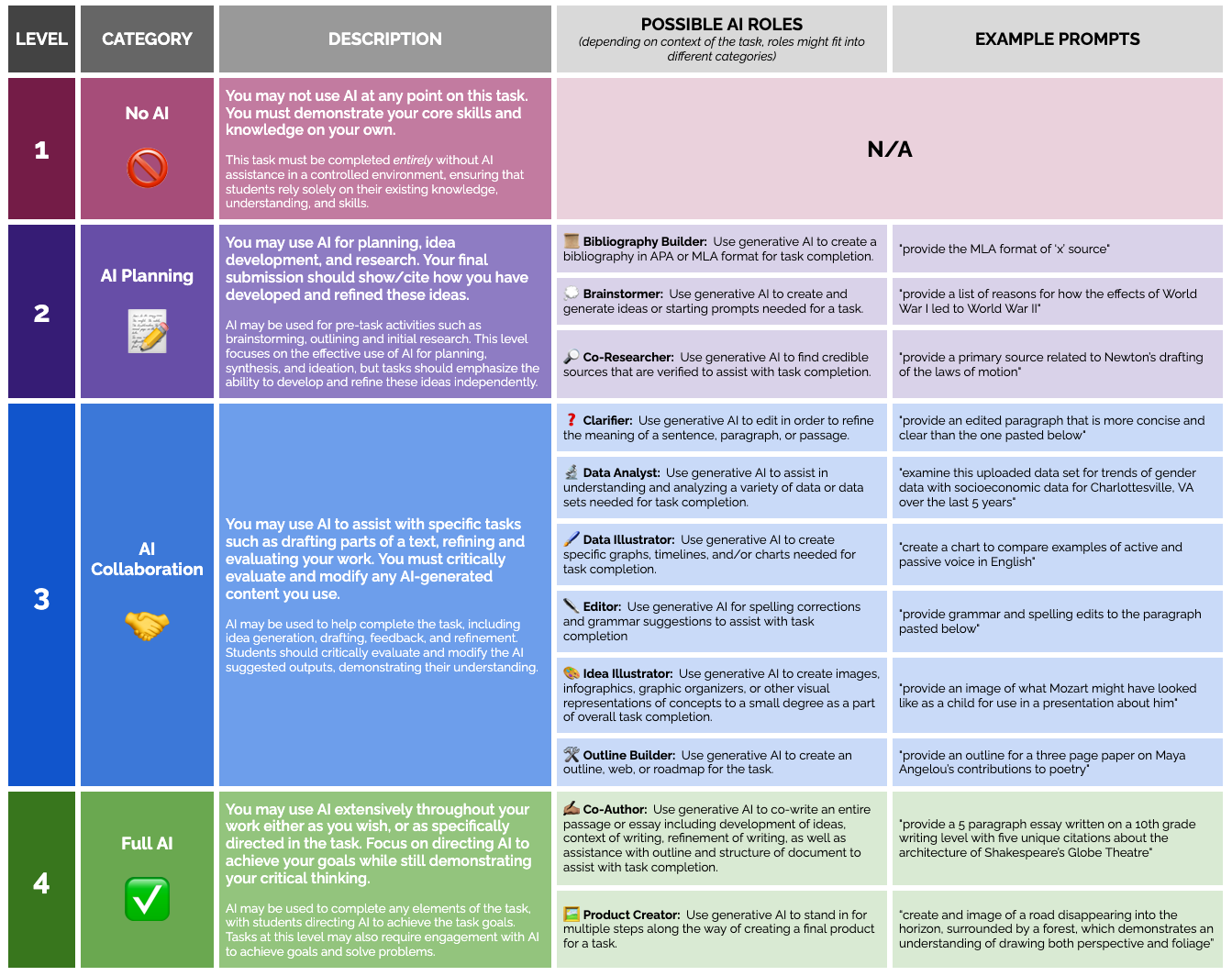
It wasn’t Dan’s conclusion that stuck with me the most. It was the way he set up the argument by contrasting the objectives of the workplace versus education.
In the workplace, the product is the thing. The report, the grant proposal, the manuscript, the R package, the Python notebook, the pitch deck, whatever. The product is the thing that matters, and here we all agree to this ideal that the human should be the lead in the driver’s seat, with AI being the associate.1
In education, the product doesn’t matter. The product isn’t the point at all.
Students produce products, but the product is seldom the point. No one wants to read the papers they write, and the math problems they solve have no practical value. Teachers have them do these tasks because they provide practice in cognitive abilities that we think matter.
The the R/Bioconductor exercises or the journal club-like essays from landmark genomics papers I assign in my class have zero value to the outside world. They exist purely so that a student practices integrating evidence, thinking about how to tackle a problem with code (even if they’ll write that code later with an AI like I do), how to build up a persuasive argument.2
Dan’s argument isn’t a total ban on AI in the classroom, but to only allow AI for things that the students already know well. He draws an analogy to calculators.
Once you’ve mastered arithmetic operations, there’s no benefit to hand calculations when you’re solving an algebra problem. But if you’re still learning algebra, don’t use the algebraic functions.
Dan goes on to steelman a few objections toward the end of the essay. I recommend reading it in full, and I’d wager after you do you’ll agree with his conclusion:
Students should only use AI for things that they already know how to do well.
Further reading:

Although please, I beg you, be respectful to yourself and to your colleagues, and don’t lower your intellectual value in your workplace to zero by simply being the meat proxy between me and an AI that I’m perfectly capable of interrogating myself. Your colleagues, bosses, direct reports, and students can all smell the Claudish in the parts-per-trillion from a mile away, and no one wants to spend an hour reading something you spent less than one minute “writing.” I’m not innocent here, but I’m trying to do better.
The vast majority of what a senior/principal scientist does in industry and academia is persuasion, sometimes in the form of persuading others to believe that our results are real and meaningful, but most often in the form of begging for money to support research and trainees.