
The Science of Responsible Innovation. My friend and colleague Alexander Titus started off 2026 with a bang on The Connected Ideas Project (TCIP) with a post on The Science of Responsible Innovation. Technology is at the same inflection point for responsibility that mature organizations reached for cybersecurity: it can’t be bolted on after launch, but must be engineered as “responsible-by-design” through requirements, metrics, testing, and continuous governance. Ethics alone doesn’t scale to complex, fast-moving systems like AI and biotech, so orgs need a discipline grounded in systems thinking, preparedness (not perfect prediction), proportional risk tradeoffs, institutional readiness, and post-deployment monitoring. Titus also gives a preview of where TCIP is headed in 2026. I’d recommend subscribing if you haven’t already.
Over the next year, TCIP will focus on building and articulating this science—through essays, frameworks, case studies, and convenings that translate responsible‑by‑design from abstraction into practice.
This is why the Science of Responsible Innovation will be the central theme of TCIP in 2026.
At the frontier of technology, humanity is the experiment. This science is how we ensure that experiment is worth running.

rv: like uv, but for R.
rvis a R package manager, written in Rust, to help users install and manage R packages in a declarative, reproducible, and fast way.Similar to tools like
uv,Cargo, andnpm,rvuses a configuration and lock file to allow the flexibility to determine how, from where, and what is installed, while maintaining reproducibility across systems and users.
Just quit. Arjun Raj launched a new Substack with this excellent first post. Quitting projects in science is hard, but we should be doing a lot more of it.
We spend a lot of time as scientists thinking about how to choose a project—and that is, of course, critically important to success. But… no matter how carefully you try to pick out the most groundbreaking, innovative project imaginable, the simple truth is that not every project is going to be awesome. Consequently, just as important as the skill of choosing a project is the skill of knowing when to quit a project.
Carl Zimmer, Lost Science (NYT): She Wanted to Improve Genetic Medicine: Brenna Henn had a long-term grant to study the genetic diversity of Africans and people of African descent. Then her N.I.H. funding was cut.
State of TechBio survey results from the Bits in Bio Slack community.
Robert Reason at Asimov Press: How Nature Became a ‘Prestige’ Journal.
The R Data Scientist 2026-01-06: Open Science & Community, Interop and Data Infrastructure, R Tooling & Publishing, Data Visualization, Mapping and Place Data, Fitness Data in R, Stats and Modeling, Academic Research.
Joe Rickert at R Works: November 2025 Top 40 New CRAN Packages. 183 new packages made it to CRAN in November 2025. Here are Joe’s picks organized into 16 categories: AI, Astronomy, Causal Inference, Data, Ecology, Epidemiology, Genomics, Machine Learning, Marketing, Medical Statistics, Risk Analysis, Shiny, Statistics, Time Series, Utilities, and Visualization.
Elizabeth Ginexi (former NIH program official for 22 years): When the System Shrinks: Living Through a Contraction in Science.
WIRED: Flu Is Relentless. Crispr Might Be Able to Shut It Down.
The Economist: The future of space exploration depends on better biology. Rockets are great, but sewage treatment is what you need for the long haul.
Matt Lubin at the Biosecurity Stack: Five Things: 2025.
As exciting as this is, biological knowledge is dual use: the same capabilities that can make humans safer and healthier can also be used to discover novel agents of harm. A Science paper from Microsoft showed that an AI was able to design genes that would produce biological toxins in a way that evaded normal safeguards meant to catch these exact types of genes. The Center for Long Term Resilience picked up a study with RAND to explore how to put better safeguards in place, but it will likely end up being a race between the capabilities of the AI gene designer and the AI gene detector. It would be nice if someone could do a technical study on which of those questions are harder (for an AI), but I’m guessing it is detection.
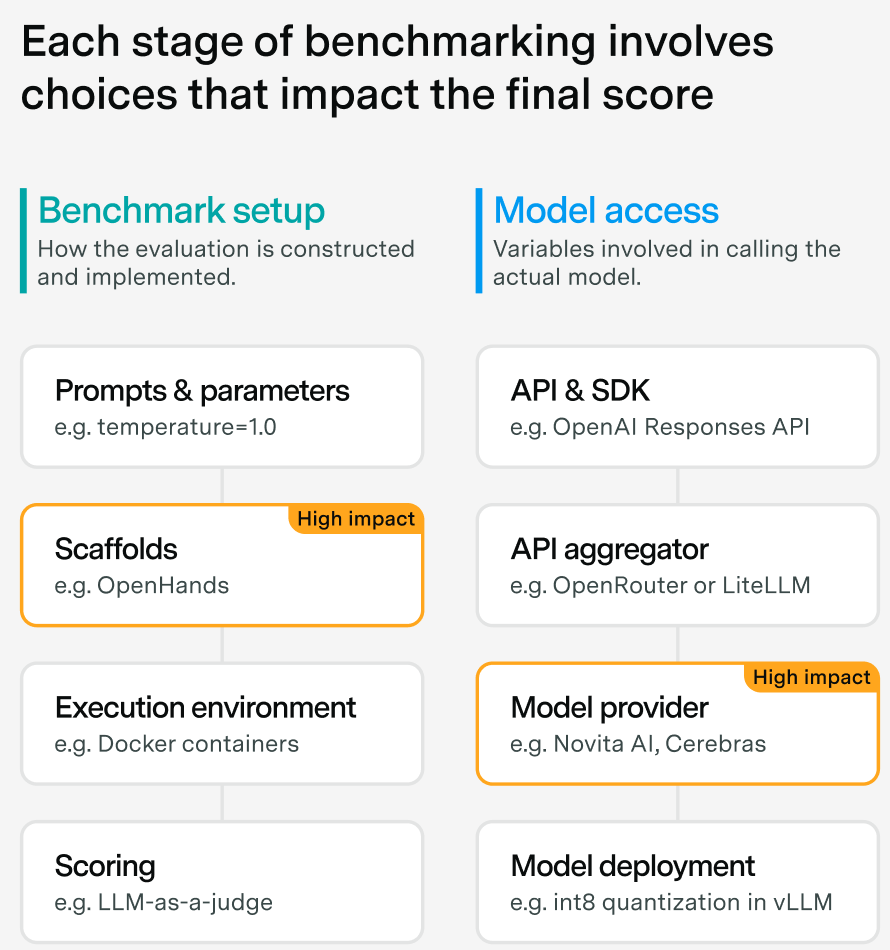
Florian Brand and JS Denain at Epoch AI: Why benchmarking is hard. Running benchmarks involves many moving parts, each of which can influence the final score. The two most impactful components are scaffolds and API providers.
Science: Is ‘open science’ delivering benefits? Major study finds proof is sparse.
Arjun Raj: Chance favors the (theoretically) prepared mind. In defense of the role of theory in innovation.
New papers & preprints:
Fast, accurate construction of multiple sequence alignments from protein language embeddings
Professional Software Developers Don't Vibe, They Control: AI Agent Use for Coding in 2025
morloc: a workflow language for multi-lingual programming under a common type system
Causal modelling of gene effects from regulators to programs to traits
High Precision Binary Trait Association on Phylogenetic Trees
Novel genes arise from genomic deletions across the bacterial tree of life
Ancestral diversity in complex disease genetics: from discovery to translation
Insights into DNA repeat expansions among 900,000 biobank participants