
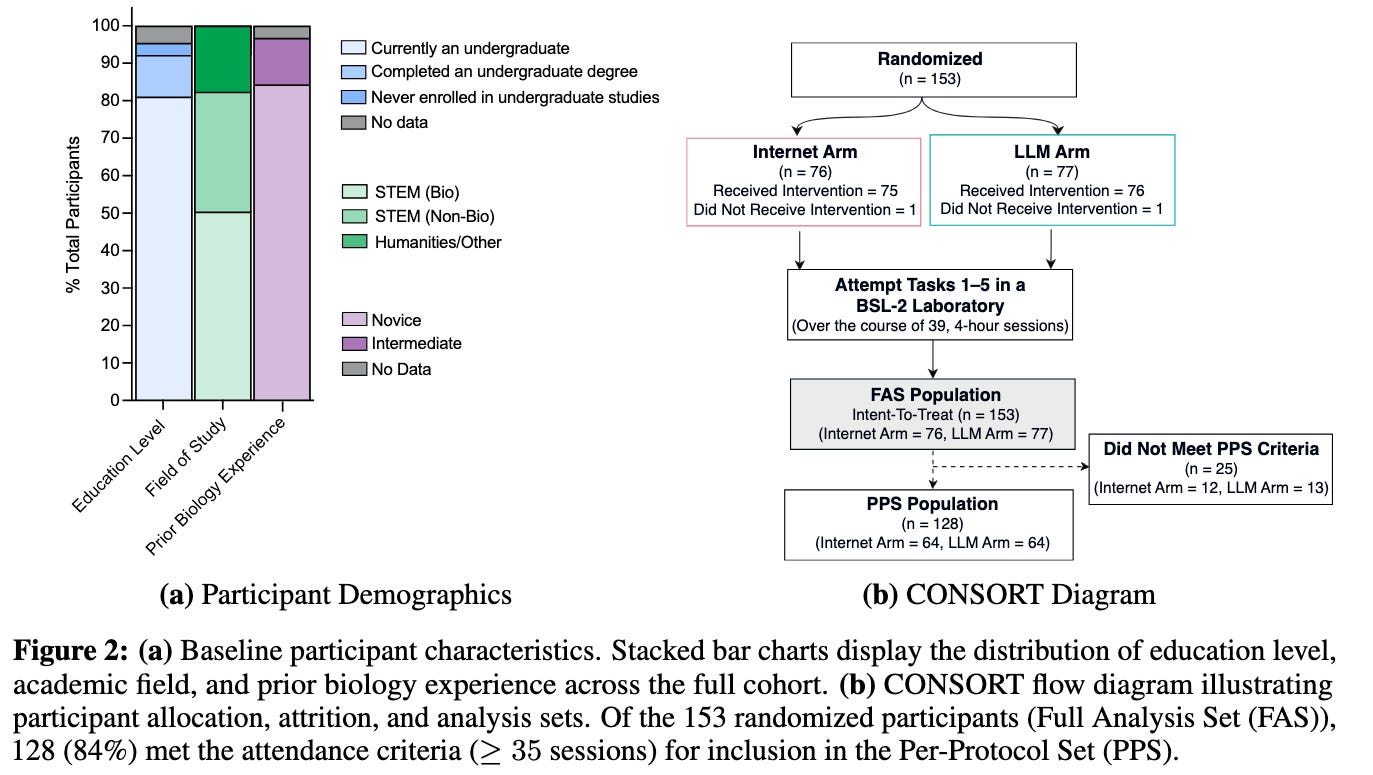
Does frontier AI enhance novices in molecular biology? That’s the question scientists at Active Site (previously Panoplia Labs) set out to answer in the largest and longest in-person RCT examining human uplift in a bio lab with AI. They recruited >150 novices without web lab experience and gave them 8 weeks to do some molecular biology work in a lab. Half could use the internet, the other half could also use mid-2025 frontier models. The result: AI models did not provide a statistically significant advantage on the most demanding measure: completing the full set of “core” tasks necessary to synthesize a virus from scratch.
The paper on arXiv: Measuring Mid-2025 LLM-Assistance on Novice Performance in Biology (chat with the paper on alphaXiv)
Blog post from Active Site: Does frontier AI enhance novices in molecular biology?
Blog post from Forecasting Research Institute: How Well Did Superforecasters and Experts Predict Wet Lab Skill Uplift from LLMs?
Summary thread from @activesite.bio on Bluesky.
One final reminder: the Call for Proposals for the 2026 Applied Machine Learning Conference is open through Feb 22. That’s this Sunday, two days from now! We’re seeking proposals for 30-minute talks and 90-minute tutorials covering topics in data science, AI, machine learning, scientific computing, and related fields. It’ll be a great conference! And I’d love to catch coffee/beer/dinner/etc with anyone coming in from out of town!
Conference dates: April 17–18, 2026
Location: Charlottesville, Virginia
Submission deadline: Sunday, February 22, 11:59pm AoE
Oh yeah, and we have a great keynote speaker lined up, Vicki Boykis!

Arcadia Science: Biology needs to become prospective. Since biological data are often non-independent, more data doesn’t always mean more insight. This essay argues that a prospective approach is needed to uncover the deepest principles of life. As summarized over at Decoding Bio:
Why it matters: Biological Foundation Models (BFMs) are experiencing a pseudoreplication crisis due to data imbalances that give rise to underlying biases. Brute force scaling by adding new sample data does not fully address this issue; in all likelihood, a different solution is needed: an informed stance regarding where new data needs to be collected. Researchers at Arcadia suggest a prospective, Bayesian approach to data collection which allows BFMs to participate more actively in the scientific process, allowing experimentalists to work to close the gaps in biological knowledge via this more directed approach.
Ethan Mollick: A Guide to Which AI to Use in the Agentic Era.
…for casual chats where being right doesn’t matter, you can use smaller models, otherwise please pick advanced models!
DOE launches OPAL, the Orchestrated Platform for Autonomous Laboratories.
The Orchestrated Platform for Autonomous Laboratories (OPAL) is a multi-laboratory initiative led by the U.S. Department of Energy (DOE) to turn biological discovery into a self-driving process. By combining artificial intelligence (AI), robotics, and automated experimentation, OPAL seeks to create a network of autonomous laboratories that can learn, adapt, and accelerate breakthroughs across biology, biotechnology, and energy science.
Sara Altman and Simon Couch: 2026-02-13 AI Newsletter: Claude Opus 4.6, GPT-5.3-Codex, Claude Code, Codex; AI in RStudio, call for posit::conf() talks, METR, news.
Andrew Holz: posit::glimpse() Newsletter – February 2026: dplyr 1.2.0, posit::conf(2026), ggplot2 v4.0.0, ellmer 0.4.0, Positron, Quarto, shinychat, plumber2, tidymodels & xgboost, orbital, ragnar, yaml12, querychat, …
With bookdown.org being decommissioned, Max Kuhn created a guide for converting books from bookdown to Quarto.
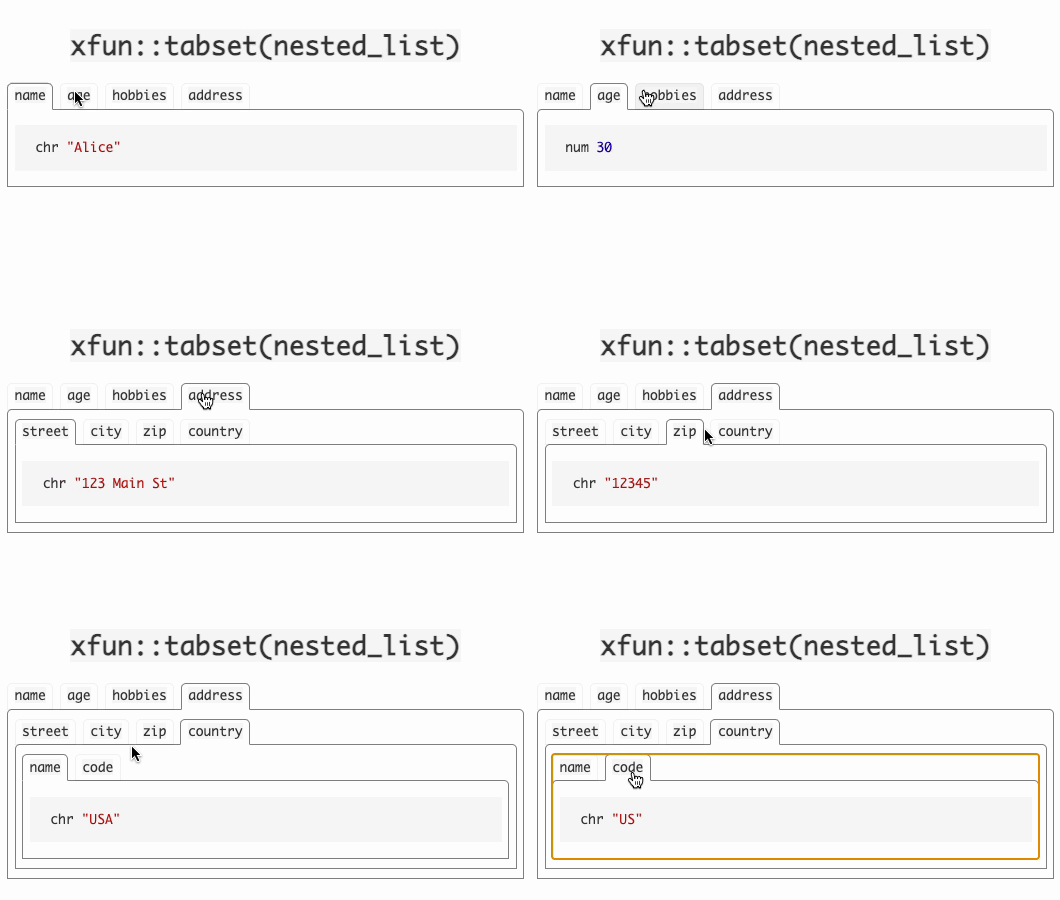
R Weekly 2026-W08: submissions working group, nested Lists with xfun::tabset.
R-Ladies Rome Tutorials: From Data to Decisions: Digital Twins for Smarter Maintenance.
Margaret-Anne Storey: How Generative and Agentic AI Shift Concern from Technical Debt to Cognitive Debt. Most readers here will be familiar with the idea of technical debt. It’s when you’re writing code and you choose the easier / faster / more expedient solution to a near-term problem that later makes your code more difficult to maintain and extend in the long run. Compare to cognitive debt:
Cognitive debt, a term gaining traction recently, instead communicates the notion that the debt compounded from going fast lives in the brains of the developers and affects their lived experiences and abilities to “go fast” or to make changes. Even if AI agents produce code that could be easy to understand, the humans involved may have simply lost the plot and may not understand what the program is supposed to do, how their intentions were implemented, or how to possibly change it.
The era of the statisticAIn? Adam Kucharski tested Claude Code with a completely fake dataset (pure random noise). It confidently found “significant” patterns and created compelling graphs to explain them. When challenged, it corrected itself, but a fresh session found different spurious patterns. The lesson: AI can give you wrong answers faster.
Nick Bostrum: Optimal Timing for Superintelligence: Mundane Considerations for Existing People.
Paul Ford / NYTimes: The A.I. Disruption We’ve Been Waiting for Has Arrived.
Atlantic: America Isn’t Ready for What AI Will Do to Jobs.
Carl Zimmer: How Microbes Got Their Crawl (gift link). In the oceans and on land, scientists are discovering rare, transitional organisms that bridge the gap between Earth’s simplest cells and today’s complex ones.
Calvin French-Owen: Coding Agents in Feb 2026.
As a solo engineer working on projects, I’m already finding that I am the bottleneck when it comes to the right ideas. More and more, ideas, architecture, and project sequencing are going to become the limiting factors for building great products.
Anthropic: Measuring AI agent autonomy in practice.
Humor: The Next Innovation in Higher Education: Vibe-Teaching™.
This instructional design reflects our commitment to inclusive pedagogy: All learning pathways are valid, whether students engage as manual human learners or outsource their consciousness to a chatbot. We support all modalities, confident that each demonstrates a different facet of multiple intelligences—or whatever we’re calling it this year.
In Vibe-Teaching™, faculty are no longer required to read the AI-generated slop that students themselves have not paused to read. We only uphold one high-touch requirement: Vibe-Teaching™ faculty must log in every two weeks to respond to the pop-up message, “Are you still teaching?”
New papers & preprints:
BioVault: A privacy-first data visitation platform for equitable global collaboration in biomedicine
Theseus: Fast and Optimal Affine-Gap Sequence-to-Graph Alignment
Genomic approaches to accelerate American chestnut restoration
A flaw in using pretrained protein language models in protein–protein interaction inference models