
Normally at the end of every month I offer a list of links to papers, articles, blog posts, etc. This month I’ll add a few podcast recommendations. Three podcasts, one episode from each.
AI Exchange: Adrienne Ghaly and Tom Williams
In this episode of the AI Exchange @ UVA podcast, Ryan Wright interviews two guests from the UVA English Department, Adrienne Ghaly and Tom Williams. From the show notes here on the AI Exchange @ UVA newsletter:
Adrienne and Tom’s partnership brings together literary scholarship and computing. Their project uses large language models to examine how novels published between 1800 and 1925 depict the natural world. The work also raises a question about what role literature plays in environmental awareness.
Adrienne is a friend and neighbor. We met at our kids’ soccer practice. She teaches a fascinating course: ENGL 3560, “The Literature of Extinction.” So when she called me last year after I left Colossal Biosciences to come here, asking me if I’d guest lecture in her course, I gave her a resounding “yes!” This was the first class I’ve ever taught in the humanities. Her students were very well read and the discussion I led around synthetic biology was unlike any I’ve had in the STEM courses I typically teach.
The podcast episode is fascinating, listening to how humanities researchers in the English department are using AI in some really interesting ways.
UVA Data Points: David Danks and Bruce Holsinger
Second recommendation is an episode from Data Points, a podcast produced here in the University of Virginia School of Data Science. This one is with David Danks (professor of data science and philosophy), and Bruce Holsinger (professor of English).
From the show notes:
A self-driving car swerves. Someone is hurt, but who’s to blame? The company? The driver? AI can’t be put on trial. It can’t go to jail, and it can’t feel remorse. So when AI makes a lethal mistake, who answers for it? […] Listen to a medieval literature expert and an AI ethicist discuss this controversial topic, because long before the age of algorithms, scholars were already asking who is responsible for our choices and what we owe to the things we create.
I bring this one up because last year I read and enjoyed Bruce’s latest novel, Culpability. Without giving too much away, it’s about what happens after a tragic car accident involving an AI-driven autonomous vehicle. The teenage son is behind the wheel, not driving, but also not focused on the road, and his mom who’s an AI researcher is in the backseat, not paying attention either. It’s a good podcast (David and Bruce share really interesting perspectives on AI and liability), and Culpability is a good novel.
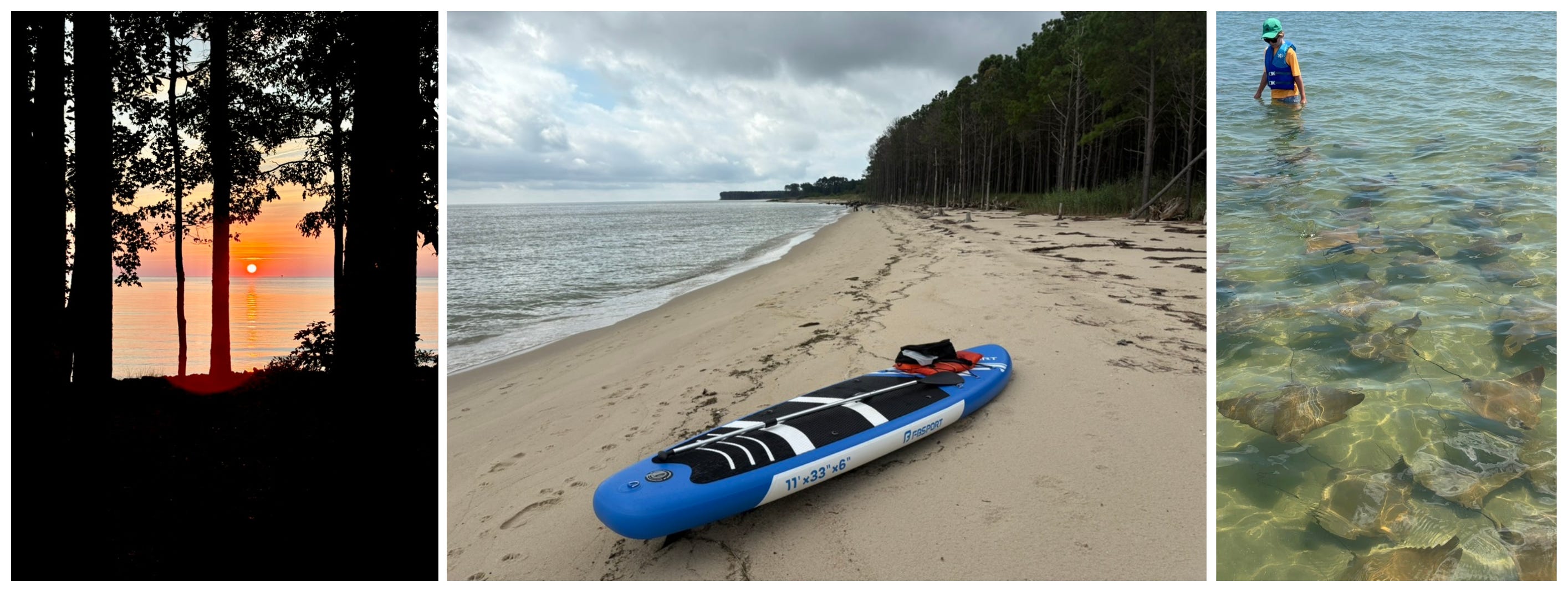
The story in Culpability was gripping, but its setting has a special place in my heart. It’s set in a little town I’m not going to name (trying to keep this place a semi-secret), in the Northern Neck of Virginia along the Chesapeake Bay. This is one of my favorite spots in the world, and we’ve been vacationing in this town for years. It’s quiet, beautiful, and because it’s shielded from rough seas in the Bay, it’s perfect for paddling along untouched coastlines that back into huge pine forests (stand-up paddling was incidentally a prominent plot device in the book). When we went there last summer we happened to be there during a massive stingray migration (photo below, right, showing my son surrounded by cownose rays). It’s a magical place. It’s great reading a novel set in a place you love and know well.
Down to a Science: Kevin Libuit with David Aanensen
My friend, colleague, fellow JMU alum, and former grad student, Kevin Libuit, started a new podcast, Down to a Science, out of his new company, Galang AI. Kevin’s name is probably familiar to you, as he ran the Bioinformatic Lab podcast for years. The new DTA Science podcast “highlights practitioners across science, technology, and business to understand their personal insights and how their work impacts our world.” The first episode featuring David Aenensen is great. I need to catch up on the others!
From the show notes:
In this episode, David Aanensen shares his journey from neuroscience and web development to leading innovations in pathogen genomics and public health surveillance. We explore how technology, visualization, and AI are transforming infectious disease monitoring and the importance of data sovereignty.