
The landscape of specialized AI shifted this week as both Anthropic and OpenAI launched dedicated health and life sciences initiatives. At first glance it looks like the two companies are pursuing fundamentally different users. Anthropic is building a specialized workbench for the laboratory and regulatory office, while OpenAI is going all-in positioning itself as a personalized health concierge for the individual.
Anthropic: Advancing Claude in healthcare and the life sciences
OpenAI: Introducing ChatGPT Health
Anthropic: A research partner for the biotech lab
Anthropic: Advancing Claude in healthcare and the life sciences
Anthropic’s latest update moves beyond general chat and into the plumbing of scientific research. The model is being positioned as a “productive research partner for scientists and clinicians” capable of handling complex bioinformatics and regulatory workflows. The most significant aspect of this release is the introduction of specialized “Connectors” and “Agent Skills” that plug the model directly into the scientific data ecosystem.
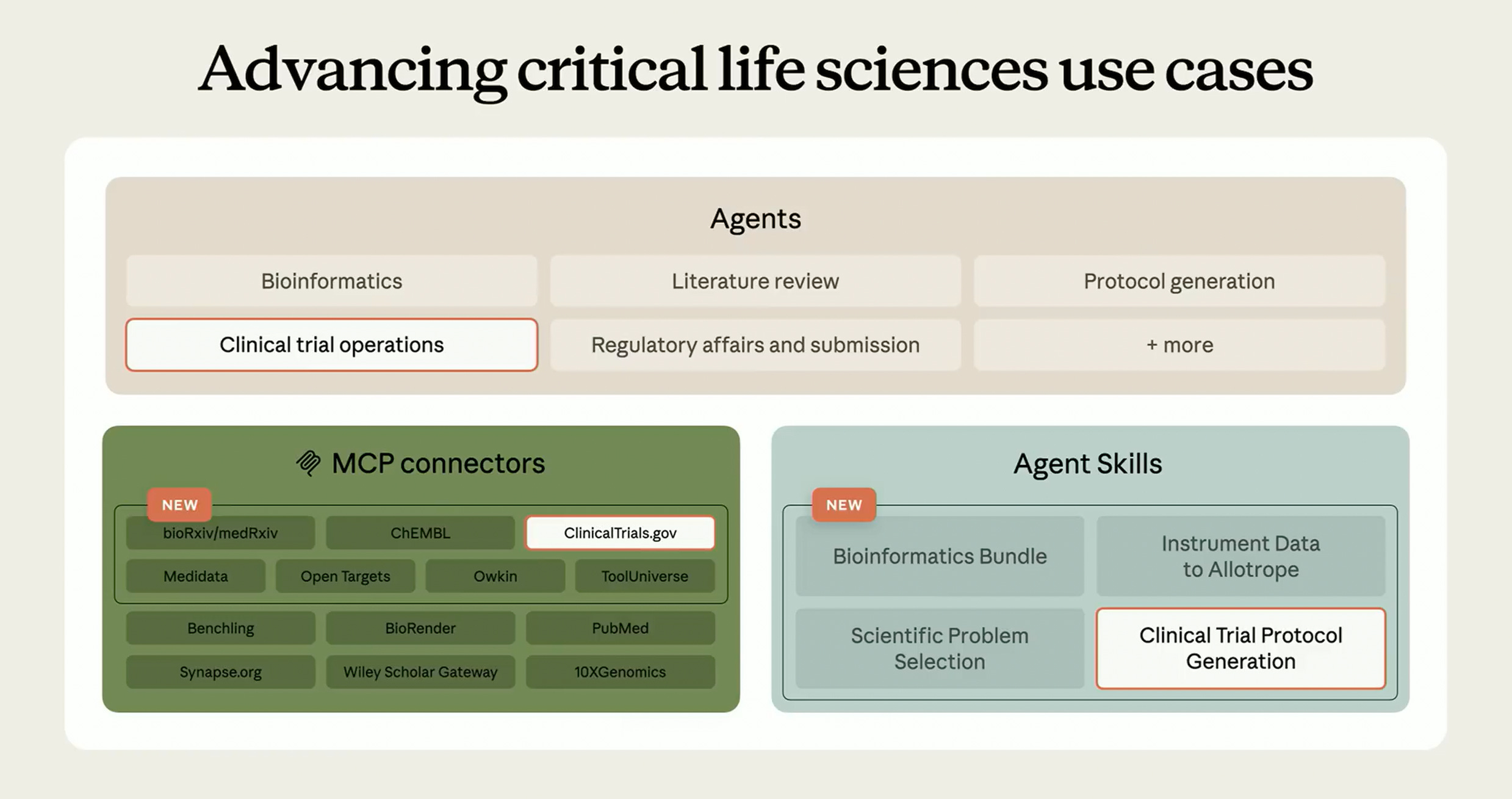
For researchers, the integration with bioRxiv and medRxiv is particularly notable, as it allows Claude to analyze and summarize the latest research before it has even passed through formal peer review. This focus on the “bleeding edge” of literature is paired with technical tools for data processing. Claude now supports Agent Skills for Nextflow deployment and scVI-tools, which are essential for managing modern genomic pipelines and single-cell RNA sequencing. From the announcement:
We’re adding connectors to:
Medidata, a leading provider of clinical trial solutions to the life sciences industry. Enabled Medidata Study Feasibility customers can use Claude to securely access Medidata’s historical trial enrollment information as well as information about site performance.
ClinicalTrials.gov, the US clinical trials registry. This provides Claude with information on drug and device development pipelines, as well as patient recruitment planning, site selection, and protocol design.
ToolUniverse, which allows scientists to use a library of over 600 vetted scientific tools to rapidly test hypotheses, compare approaches, and refine their analyses.
bioRxiv & medRxiv, the life sciences preprint servers. When connected to bioRxiv & medRxiv, Claude can access the latest research before it’s formally published.
Open Targets, which supports the systematic identification and prioritization of potential therapeutic drug targets.
ChEMBL, the bioactive compound and drug database, which will help Claude support early discovery work.
Owkin, whose Pathology Explorer agent analyzes tissue images to detect cells and map tumors, designed to accelerate drug discovery and development.
These join our existing Life Sciences connectors to Benchling, 10x Genomics, PubMed, BioRender, Synapse.org, and Wiley Scholar Gateway. Our Benchling connector is now also available via Claude.ai on the web (in addition to the Claude desktop app), with secure access via SSO.
Finally, we’re adding new Agent Skills for scientific problem selection, converting instrument data to Allotrope, and supporting bioinformatics work with skills bundles for scVI-tools and Nextflow deployment. We’re also adding a sample skill for clinical trial protocol draft generation. These drafts include endpoint recommendations and account for regulatory pathways, the competitive landscape, and relevant FDA guidelines.
On the healthcare front, in addition to the research angle, Claude now has connectors to the Centers for Medicare & Medicaid Services (CMS) Coverage Database, the International Classification of Diseases, 10th Revision (ICD-10), and the National Provider Identifier Registry, with skills for FHIR development and prior authorization reviews. They’re claiming that Claude can accelerate prior authorizations, claims appeals, coordinating care and triaging patient messages.
On the consumer-facing health front, subscribers can give Claude access to Apple Health and Android Health integrations for summarizing history, detecting patterns across fitness and health metrics, etc.
You can watch the announcement here:
OpenAI: The patient-facing health integration
OpenAI: Introducing ChatGPT Health
OpenAI isn’t adding much in the way of assisting health and life sciences researchers. In contrast, OpenAI is leaning into the consumer experience with ChatGPT Health. This dedicated space is designed to help individuals navigate their own health journeys by securely aggregating scattered data from medical records, wearables, and wellness apps. It is built as a separate environment where health conversations are compartmentalized from general chats and are (supposedly) not used for model training.
The utility here is synthesis for the layperson. By connecting to Apple Health, MyFitnessPal, or lab results via the b.well network, a user can ask for a summary of their cholesterol trends or prepare specific questions for an upcoming doctor’s visit. While OpenAI notes that they collaborated with over 260 physicians to refine the model’s tone and safety, they are clear that this tool is for support and information, not for diagnosis or treatment.
First impressions, the ChatGPT update looks rather scattershot, and smells more like a partnership that could end up using your health data to sell you products (Instacart) or services (Peloton, Weight Watchers).
Bring your medical records and the apps you use to track your health and wellness into Health. You can upload files directly, connect from tools (+) or “Apps” in Settings.
New: Medical Records for lab results, visit summaries, and clinical history
New: Apple Health for health and fitness data, including movement, sleep, and activity patterns (must be on iOS to sync)
New: Function for lab test insights, nutrition ideas, and taking action on your health
New: MyFitnessPal for nutrition advice, macros, and recipes
New: Weight Watchers for GLP-1 personalized meal ideas, recipes, and food guidance
AllTrails to help you find your next hike
Instacart to turn meal plans into shoppable lists
Peloton for suggested workout classes or guided meditations
It’ll also be interesting to see how the practice of primary care / family medicine changes with updates like the one below. For years I’m sure people have been coming into their doctor’s office asking about zebras after WebMD-assisted self-diagnosis.
Chat about your health. Health conversations feel just like chatting with ChatGPT—but grounded in the information you’ve connected. You can upload photos and files and use search, deep research, voice mode and dictation. When relevant, ChatGPT can automatically reference your connected information to provide more relevant and personalized responses. For example, you might ask: “How’s my cholesterol trending?” or “Can you summarize my latest bloodwork before my appointment?” To use a connected app you can start your question with it, select it from tools (+) or ChatGPT may suggest one when helpful.