
I’ve had a busy week, taking the day off today, and I haven’t had a chance to do much reading. I’ve been spending a ton of time lately developing a new course I’ll be teaching this fall, and preparing a workshop on AI-powered literature review and synthesis I’ll be teaching next week (if you’re at UVA, register and attend for the in-person event if you can — it’ll be much more engaging than Zooming in, trust me).
Here are my open browser tabs I have open that I hope to catch up on soon.
Blogs/newsletters/etc
A cell is not a spreadsheet- why “Virtual Cells” are still mostly hype
Bots are scraping open data — how should researchers respond?
How to build a cancer vaccine, and whether they will work this time
Papers
The total eclipse of bioinformatics: From disruption to convention, and a gentle warning
Dual-use artificial intelligence and biology: upstream risk-benefit reviews
Molecular de-extinction looks to the past to find the molecules of the future
AutoScientists: Self-Organizing Agent Teams for Long-Running Scientific Experimentation
Pleiotropic shared heritability quantifies the shared genetic variance of common diseases
Depth normalization for single-cell genomics count data and Lior’s explainer
I just read this one right before posting. The post describes the difficulty agents have at retrieving biological data. Which isn’t limited to agents! It’s difficult for a human to navigate the disparate databases and web interfaces and NCBI Virus search incantations to get the thing you’re looking for. If this problem were solved for agents, it’d make life easier for us humans as well. A conclusion from the post: “We want models to be creative when they generate hypotheses, design experiments, or reason about mechanisms. But the layer underneath that creativity—gene identifiers, schemas, retrieval logic, coordinate systems, metadata conventions, and data access paths—has to be boringly reliable (or in other words, deterministic)”.
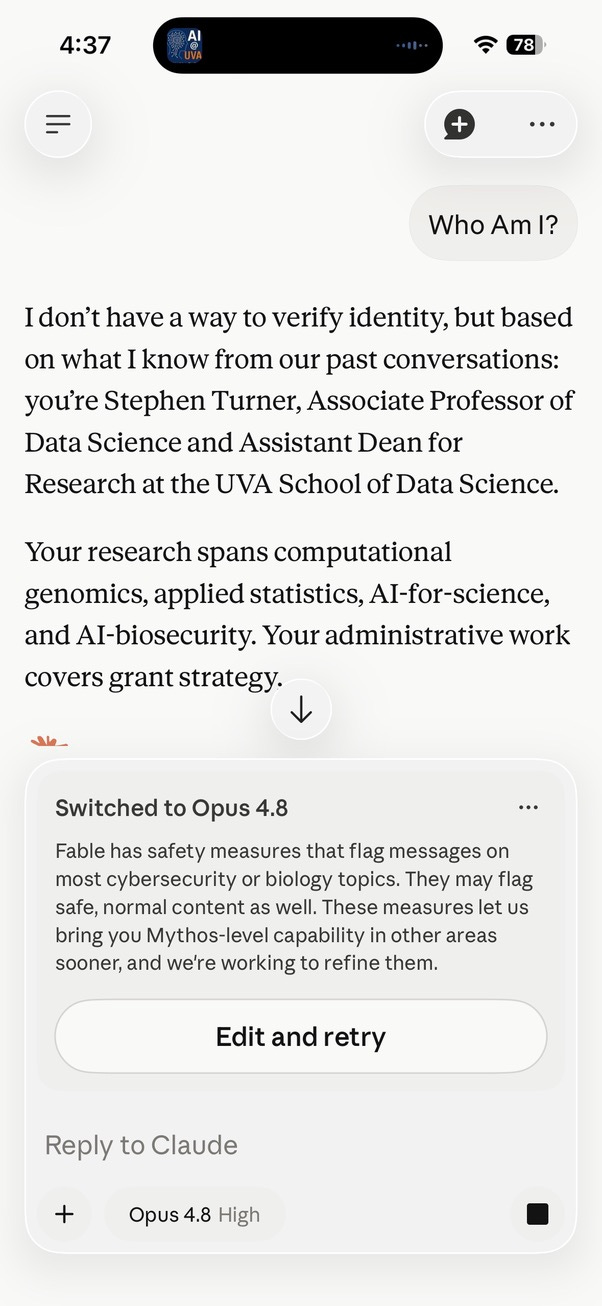
I haven’t had a chance to do anything with Fable yet, mostly because I work in AIxBio, and Bio is off limits. And because I’m a biologist, Fable refuses to talk to me (“Who am I?” leads to safety flags and demotion of the rest of the conversation to Opus). Precautionary principal is probably the right move here given the benchmarks, and I think managed access will likely be the way these models are released from here out.
Friendly note: "Is AI More Expensive Than the Employees It’s Replacing?" is duplicated.