
A short week for me here. Just ahead of the Opus 4.8 launch, two of these (writing/creativity and the despair of professors) hit the same theme, so they’re stacked at the top. Next, the ESMFold2 release I haven’t fully digested, a message from the pope on AI, and a piece of NIH news for researchers with foreign co-authors.
1. Choosing to stay human, and what 370,000 college essays say about that
Two pieces from different authors converging on a similar point, and one I’ll be writing about next week as well.
Ethan Mollick’s essay Choosing to Stay Human isn’t necessarily arguing against using AI or even AI for writing, but focuses on what to hand over. He’s fine offloading phone numbers, arithmetic, cursive. He’s not fine reflexively offloading writing, because writing is one of those tasks where the doing is the point. He cites his own BCG consultant study and a pair of Wharton-affiliated education experiments where small differences in classroom AI deployment produced opposite outcomes. In Turkey, students with plain ChatGPT did worse on tests than students without it. In Taipei, students with an AI tutor that gave personalized problem sequences scored 0.15 SD higher, roughly six to nine months of additional schooling.
Related is companion piece is Rebecca Winthrop’s NYT op-ed on a Georgetown research program led by Adam Green that has been tracking college application essays before and after ChatGPT. In a study of 370,000+ personal statements, post-ChatGPT essays got rated as more creative by human judges while offering fewer novel ideas. A separate study found human-written essays contained up to 8x more new ideas than AI-assisted ones. The homogenizing effect was largest on students furthest from the mean, including neurodivergent students and racial and linguistic minorities. I.e., the kids whose voices are most distinctive are the ones most flattened by the assist.
Stay tuned next week. I’m writing a very short piece on the topic.
2. The despair of the professor
The natural sequel is Jay Caspian Kang’s New Yorker piece, “The Despair of the Professor in the Age of A.I.” collecting testimonials from faculty members about what AI has done to their teaching. Hard to read. But nothing in it is surprising (I’d guess most academics have heard versions of these stories from colleagues).
The piece opens with Jane Sloan Peters, a religious studies professor at Mount Saint Vincent, describing a course she’d taught for years called “Letters from Prison.” Before AI, students struggled to land on themes and arrived somewhere personal through that struggle. Last year, every one of her students turned in something polished and empty.
From Beth Ritter-Conn at Belmont, on her honors students:
The tipping point was last year when I had Honors students—Honors students!—using A.I. to write reflection journals. Literally the only task there is “tell me what you are thinking inside your own head.” There is no right or wrong answer. It’s just, Give me your thoughts on this thing. And I had students who outsourced that task to the robots.
From Susanna Boxall, a philosophy lecturer at Chico State, on online classes:
Now, online classes are a simulacrum of education: the students pretend to learn, and I have to pretend that I am teaching them something.
From Neal Hebert at Grambling State, who teaches theater and now assigns plays too obscure for ChatGPT to know about:
I’ve stopped being a collaborator in these intro courses and started being a plagiarism cop, and I do resent that a bit.
And from Jeremiah Croster, who teaches English at Houston City College:
The get-a-degree approach was already winning even before A.I., but now that it’s here, the education part is starting to feel like something someone will write about in a history book. Or maybe A.I. will do it.
Not every voice in the piece is despairing. Auyon Siddiq at UCLA Anderson made his stats exam fully AI-permitted and reports the average is still 75%, because students who don’t understand the material aren’t saved by the tool. Daniel Silver at Toronto Scarborough redesigned his sociology assignments as multi-agent simulations and says the best final projects showed more creativity than what he used to get. So it’s not uniformly grim, but the dominant note is loss.
3. ESMFold2 and the protein biology “world model”
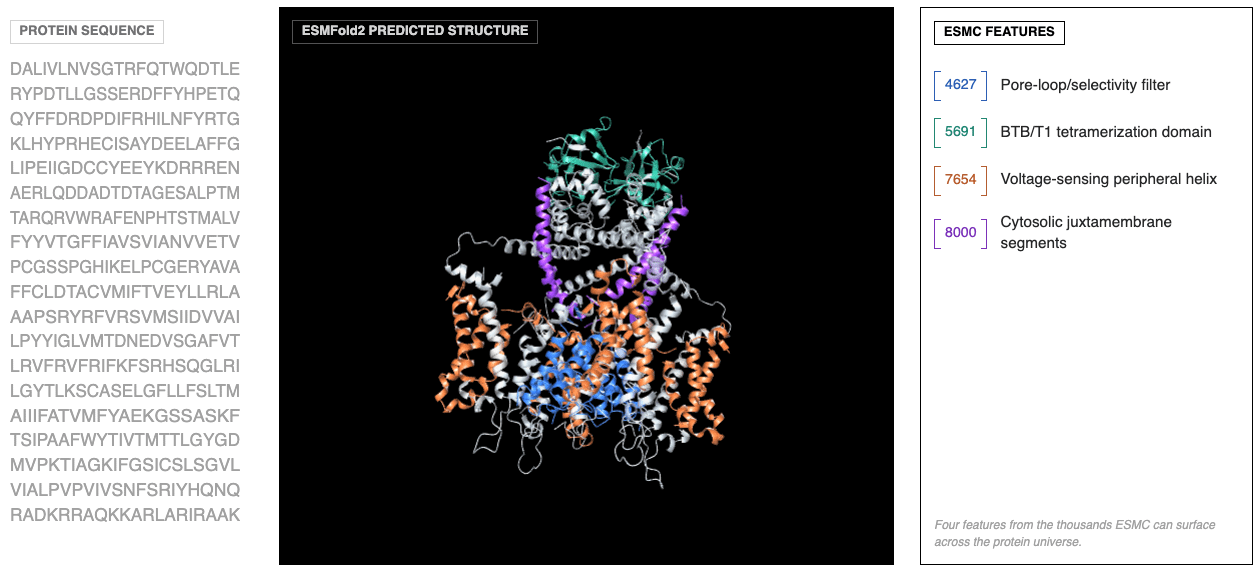
Biohub (formerly known as EvolutionaryScale, now merged with the CZ Biohub network) announced ESMFold2 and a new ESM Cambrian (ESMC) family of protein language models this week, alongside an atlas of 6.8 billion protein sequences with 1.1 billion predicted structures. The paper is long and I haven’t read it, so I’ll be careful here.
What Alex Rives says in his thread, in his words: ESMFold2 is state of the art on protein interactions, especially antibody-antigen complexes. They designed and experimentally validated miniprotein binders and single-chain antibodies against five therapeutic targets with good hit rates including a PD-L1 minibinder that restores T-cell signaling at functional IC50 comparable to atezolizumab. They describe this as evidence that the model has materialized “a world model of protein biology.”
What is a “world model” anyway? Seems like “world model” is doing a lot of marketing work in AI right now, with no agreed-on technical meaning. Whether calling it a “world model” adds anything beyond “the representations are structured in biologically meaningful ways” is a fair question, right?
Either way, a quick look at their press release benchmarks and binder design results all look exciting. I’m looking forward to seeing what holds up under peer review.
4. Pope Leo on AI
Jill Lepore’s New Yorker piece on Pope Leo XIV’s new encyclical Magnifica Humanitas provides a nice overview for those of us without time to read the 40k+ word papal document on AI. Tech leaders have spent 20 years borrowing the rhetoric of mission, salvation, and disruption from religion, and the first American Pope, who took his name in reference to Leo XIII’s 1891 Rerum Novarum on industrial labor, has decided to reclaim the territory. From Lepore:
Little in the encyclical is surprising; its force lies in its being said all at once.
I haven’t read the whole encyclical yet so I’m not going to summarize it. It’s interesting that (and this is partly Lepore’s read but also visible in a quick skim of the text itself) part of the encyclical is about language and writing. There’s a whole subsection on “an ecology of communication.” The Pope and Ethan Mollick and Rebecca Winthrop in #1 above are, in different vocabularies, worried about the same thing, that we are losing the conditions under which humans develop their own thoughts.
Our first task is neither to demonize nor idolize technological tools, but to utilize them on the basis of a fundamental principle, namely that truth is a common good and not the property of those with power or influence. We must therefore promote an ecology of communication.
Just pausing to say here that I find it amusing and puzzling that the company I keep who’d normally be first in line to criticize the Church, its anti-scientific doctrine, and its history of abuses, are now lining up behind the Pope as soon as he says something critical of AI. Cat’s post on the topic stuck with me.
5. NIH’s reinterpretation of “foreign component”
Jeffrey Brainard at Science reports that NIH grant managers are privately telling investigators they need pre-approval for any co-authorship with a scholar affiliated with a foreign institution, even when all the work was done in the United States. NASA is reportedly doing something similar for collaborations with researchers in China. Neither agency has issued public guidance.
The mechanism is that NIH has long required approval for grants with a “foreign component,” historically defined as significant scientific work performed outside the U.S. Now NIH is suggesting that mere coauthorship with someone at a foreign institution now counts as a foreign component, regardless of where the work happened. NIH is asking grantees to remove papers with foreign coauthors from annual progress reports if no foreign component was originally approved. An NIGMS email seen by Science asks institutions to promise that flagged U.S. authors won’t collaborate with the relevant foreign coauthors in the future.
This creates pressure to remove foreign-affiliated coauthors from papers before submission, which violates standard publication ethics. Foreign-affiliated coauthors include visiting students and postdocs temporarily in the U.S., collaborators who donated reagents but didn’t run experiments, and U.S.-trained scientists who moved abroad after the work was done. The rule is seems to be administered through private emails rather than formal guidance which means it can shift without anyone being able to point to the rule that changed.