
Of the roughly 20,000 PubMed papers that use “gain of function” in their title or abstract (try the search here), only 15 describe experiments that meet the federal criteria for the dangerous kind. That count comes from a new review in Frontiers in Bioengineering and Biotechnology by Gene Godbold and colleagues at Signature Science,1 Battelle, and RAND’s Center for AI, Security, and Technology (CAST).
Godbold GD, et al. (2026) Discerning dangerous gain of function: most gain of function (GoF) research does not involve infectious microbes. Front. Bioeng. Biotechnol. 14:1818657. doi: 10.3389/fbioe.2026.1818657.
A May 2025 executive order prohibits federal funding for dangerous gain of function (DGoF) research, defined through the 7 DURC criteria written into the 2012 dual use policy: enhancing harm, defeating immunity, conferring drug resistance, increasing transmissibility, altering host range, raising host susceptibility, or reconstituting an eradicated agent. The order also calls for a way to govern such work outside federal funding. Which research the term covers has become a funding and legal question, i.e., not just semantics.
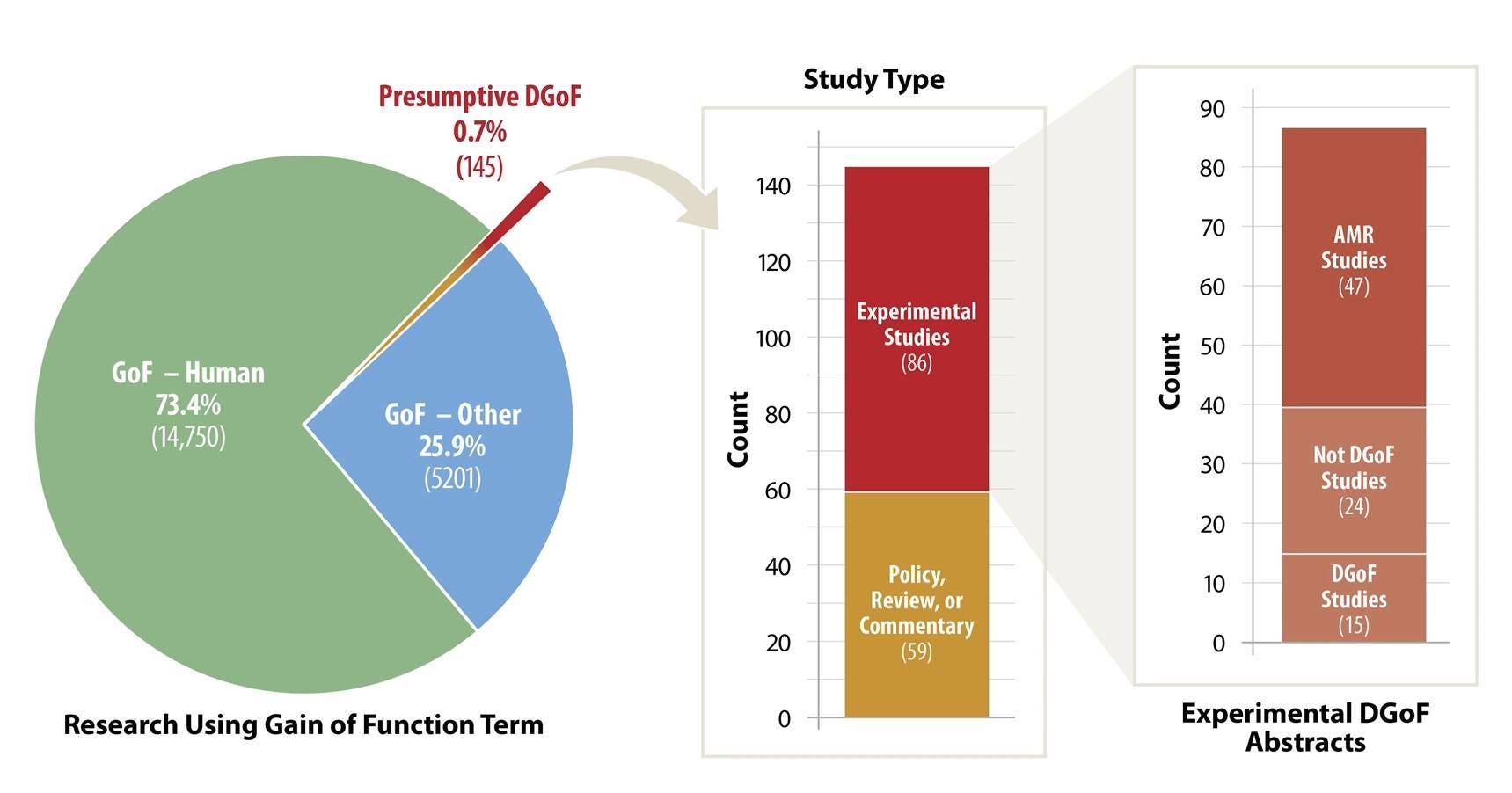
The authors began with 20,099 papers, filtered them with dictionaries and named-entity extraction, then read titles and abstracts by hand. Over 73% concern gain of function mutations in human disease, cancer, neurobiology, and similar areas, with no microbe in sight. Among the 86 experimental papers in the presumptive DGoF set, most investigate antimicrobial resistance in fungi and bacteria, work that stays inside the original organism. Fifteen fulfilled the DURC criteria.
On the flip side, most research that does meet the DGoF definition never calls itself gain of function. The team documents 62 papers that move a sequence of concern into a heterologous microbe and give it a new pathogenic function, and only 12 use “GoF” anywhere in the title or abstract. Screening on the keyword would miss most of the research oversight is meant to catch.
Trained reviewers also disagree on the edge cases. Three biodefense professionals, each with more than 15 years of experience, evaluated 22 viral papers. They agreed on 9 as DGoF and 6 as not, and split on the remaining 7.
Godbold’s group offers what they have been building for over 20 years: a function-based catalog of sequences of concern, paired with the DURC criteria, so a reviewer can ask what a gene does to a host rather than whether a paper used a particular phrase. For oversight that has to draw clear and defensible lines, that is a steadier handle than the words authors pick for their own abstracts.
Disclosure: I have worked with, worked for, consulted, and collaborated with Signature Science LLC and several authors on this paper for over 15 years.
Thanks Stephen--that's an excellent synopsis. GoF is a *bad* proxy for "bad biology".