
One of the things I love about teaching is that it forces you to confront assumptions and a million little things you don’t fully understand, in case that curious student of yours asks you about it.
I’m preparing a lecture for tomorrow morning about various population sequencing projects, from HapMap to 1000 Genomes to ExAC to GnomAD. While preparing to teach the International HapMap Project, I paused for a sec at CEU, a French acronym attached to Utah families from the initial phase of the HapMap project.
Through my 20-something years in this field I think I’ve been really sloppy about throwing around different terms for these samples. CEU. CEPH. Coriell. What’s the story here? I did a little digging.
Let’s step back to the 80s and 90s. Jean Dausset shared the 1980 Nobel Prize with Baruj Benacerraf and George Snell for research on immune regulation, including Dausset’s work on HLA. Proceeds from paintings bequeathed by Hélène Anavi helped him establish the Centre d’Étude du Polymorphisme Humain in Paris (foundation biography, earlier account). CEPH opened in 1984 and became a foundation in 1993. Dausset founded it with Daniel Cohen, Howard Cann, and Mark Lathrop (history, overview).
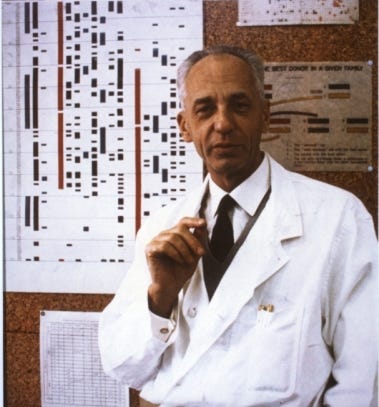
CEPH distributed DNA from the same large families to mapping laboratories and combined their genotypes into one database. They created EBV-transformed lymphoblastoid cell lines to provide a renewable source of DNA. The Coriell Institute holds records from 61 families and 809 people. From CEPH:
The Centre d'Etude du Polymorphisme Humain (CEPH), Foundation Jean Dausset, Paris, France has contributed its collection of 61 reference families to the Repository. The CEPH collection includes families collected by R. White (Utah), J. Dausset (French), J. Gusella (Venezuelan), and J. Egeland (Amish). There are a total of 809 individuals accounting for 832 pedigree positions in the reference families.
The first comprehensive genetic map of human chromosomes in 1987 used 21 families and 403 loci, including 393 RFLPs (paper). CEPH described the collaboration in 1990; the 1992 NIH/CEPH map contained 1,416 loci.
CEPH lists 48 Utah families, 10 French, one Amish, and two Venezuelan (breakdown); Utah currently counts 47 pedigrees. Large families and genealogical records helped attract Ray White to Utah (history, Prescott et al.). The wider Utah Mormon population (aka The Church of Jesus Christ of Latter-day Saints) had very low inbreeding and resembled northern European populations (O’Brien et al.). CEU covers one narrow ancestry sample and can’t represent all Europeans.
The Coriell Institute in Camden, New Jersey, USA maintains the NIGMS repository and separate NHGRI collections. CEPH/Utah materials are distributed through NIGMS. Coriell describes their use in their HapMap collection. GM12878 identifies an EBV-transformed B-cell line; NA12878 identifies derived DNA. Coriell holds lines from 153 CEU grandparents.
CEU is the population code for “Utah residents (CEPH) with Northern and Western European ancestry” (IGSR). The CEU “Central EUrope” wording is a backronym. The HapMap project was described in 2003. Phase I finished with 269 people including 30 CEU trios, 30 YRI trios, 45 unrelated CHB participants, and 44 JPT participants.
HapMap kept the CEPH label so new genotypes could be combined with earlier results. From Rotimi et al.:
The CEPH samples studied for the Project were collected in 1980 from residents of Utah whose recent ancestors came primarily from northern and western Europe. The label CEPH is an acronym for the Centre d’Etude Polymorphisme Humain, the organization that originally collected the samples. Cell lines for the CEPH samples have been publicly available since 1992 from the Coriell Institute. […] HapMap investigators wanted to build on this valuable body of existing data, and thus chose to use a subset of these same samples to develop the HapMap. Although the original complete CEPH sample set includes some samples from individuals in France and Venezuela and individuals identified as Amish from Pennsylvania, only samples from the Utah CEPH donors were used for the Project. Although the CEPH population is the only one whose samples are included in the HapMap to be known by an acronym, investigators chose to retain this population label for the Project so that the HapMap data could be readily integrated with preexisting data from other studies of these samples without engendering confusion within the scientific community.
Investigators recontacted Utah donors by mail, telephone, and home visits. Utah researchers retained confidential identity links. Those links stayed in Utah, and that prevented Coriell and HapMap from returning individual results or processing individual withdrawal (for more details on this see the HapMap ethics paper). Current discourse in 2026 concerns deriving iPSCs from samples collected under consent forms that predated the technology (see this 2026 preprint).
NA12878 belongs to CEPH pedigree 1463. She is the adult offspring of NA12891 and NA12892, and mother of 11 in the 17-member Platinum Genomes pedigree. Her DNA became the Genome in a Bottle pilot and NIST RM 8398. From GM12878 we got a 2018 MinION human-genome assembly using ultralong nanopore reads (preprint, final paper). Researchers can order the cell line or DNA from the Coriell Institute.
TL;DR? CEPH organized the families, Utah supplied most of them, Coriell distributes the materials, and CEU specifically names the HapMap subset.
Cher Stephen,
Merci pour cette petite leçon d’histoire des familles qui ont participé à notre compréhension du génome humain.