
Here are some of my open browser tabs from the last two weeks. See also part 1.
Some Scientists Have ‘Magic Hands’ in the Lab. This A.I. Is Learning Why, by Carl Zimmer
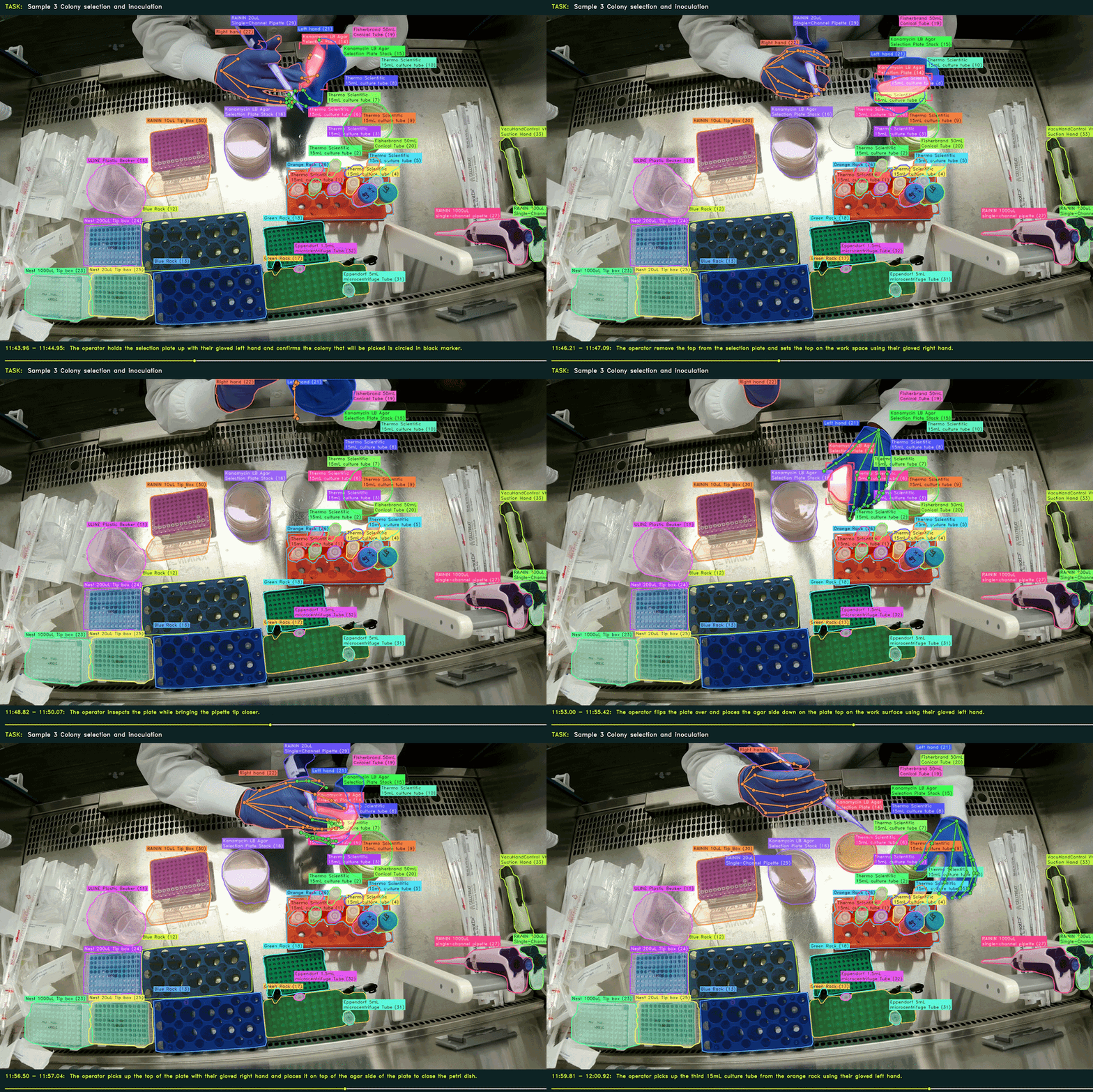
With Transfyr, Dr. Wegrzyn and Ms. Wagner are building a system that can slurp up enormous amounts of data about what happens in a lab, in the form of video, audio and sensor logs from lab equipment. Transfyr even tracks the source of supplies, down to the lot numbers of glove boxes.
I had to unplug from AI to rediscover my love of writing by Bastien Le Guellec
I realized writing is a process that not only transforms ideas into text, but also allows the writer to continuously question and refine those ideas. The AI never did this.
What Do Students Lose When They Stop Writing? by Dana Goldstein
Writing builds our working memory, executive planning skills and metacognition — the ability to think about our thinking, weigh alternate viewpoints and revise for clarity and style. It takes decades to develop writing skills, from toddlerhood into adulthood.
Building a three-day early-warning system for novel pathogens, by SecureBio and Jeff Kaufman
The OpenAI Foundation has granted SecureBio Detection $17.2M to reduce our end-to-end time from fourteen to three days, expand our collection footprint, and further validate our detection system.
Come build the OpenAI Foundation, by OpenAI Foundation
In March 2026, we announced the Foundation’s initial hires and shared our goal to invest at least $1 billion over the next year across areas including AI Resilience, Life Sciences and Curing Diseases, and AI for Civil Society and Philanthropy and we are well on our way.
Treat biological databases as infrastructure, not projects, by Neil Hall, Katja Röper, Valerie Wood & Paul Nurse
We urge funders to treat biological databases as a shared infrastructure, as they do biobanks and particle accelerators. Without sustained investment, the life sciences risk building an ambitious future on a collapsing foundation.
Professors Were Singled Out for Using AI in Public Writing. Now They’re Defending Themselves, by Alexandra Crosnoe
“I would be completely fine with the idea to write that AI is a co-editor, but it did not contribute to any ideas,” Stankova said. “And you know why? Because this op-ed, for me, is not an opportunity to gain fame, to gain recognition. This is not a literary piece for me. This is a way to disseminate information, to disseminate the core arguments there.”
AI and the New Age of Bioweapons by Elizabeth Sherwood-Randall
Policymakers need a new strategy in response—one that accepts that biological attacks are likely and prepares to contain the harm, helps the country recover more quickly, and uses new tools to identify and hold perpetrators accountable. Ultimately, this resilience to biological attacks could dissuade malicious actors from attempting to use them in the first place, knowing that the effects will be minimized—a strategy of deterrence by resilience.
Forecasting the Impacts of Anthropic’s ASL-3 Safeguards on Biosecurity Risks by Forecasting Research Institute
This comparison has an important limitation: the “no GPAI” scenario is an imperfect proxy for perfect safeguards. Perfect safeguards would eliminate the risk of misuse while preserving the defensive benefits of GPAI, such as contributions to pandemic surveillance and vaccine development. The “no GPAI” scenario removes all of these. This means the “no GPAI” world is likely more vulnerable to outbreaks (including human-caused ones) than a world with perfectly safeguarded GPAI, making it a lenient benchmark.
Defining Sequences of Concern by Tessa Alexanian
So we’ve been doing this project with a lot of other screening tool providers to try and cordon off these zones. We’re going to expand the set of sequences that we all agree are low risk. We’re going to expand the set of sequences where we have a consensus that they are high risk. And we’re going to label this stuff in the middle, where nobody should get in trouble for whatever they do in terms of screening, because we don’t understand it scientifically.
How Claude is accelerating protein design and analytical chemistry by Anthropic
We have now received wet lab data back for the first of these experiments, a multi-arm protein design campaign against 15 targets using Claude Opus 4.8 and Mythos Preview. Our external evaluators, Adaptyv Bio and Twist Bioscience, independently produced and tested Claude’s designs in the lab, finding that of the 15 targets we designed against, Claude successfully designed binders against 14 of them.
Protein language models are overly constrained by covariation by Claus Wilke
we’ve still only scratched the surface with respect to understanding what pLMs are actually good for. I have no doubt that they are an amazing tool that will have profound implications for the future of protein science. However, this does not mean that these models are currently used appropriately. Clearly, zero-shot predictions from pLMs are not that useful, in particular not if the goal is to find variants that provide novel function.
Where have organoids actually been useful? by Abhishaike Mahajan
It’s really quite extraordinary. I understand the tendency to get a little grumpy about how the cleverness of strange preclinical research seems to never quite connect with reality, but we really need to hand it to the organoid folks here. Unlike the chemotherapy case, the 3D-ness of organoids seemed necessary for the assay to work. And thanks to it, at least a few people have gotten the chance to access a drug that could dramatically improve their quality of life.
The problem(s) with tech in bioteh by Jesse Johnson
Biopharma innovation happens at the boundaries of knowledge but ML models are mostly good at generalizing within the bounds of their training data. Are we expecting them to extrapolate beyond their limits?
How to write safe software for science by Erin McAuley
These outputs are not about what the software “should do” but what it currently does, and you treat those outputs as the expected results. As you make changes to your software, you periodically cross-check your newly generated results with those expected results. This is your safety net!
Peer review is overwhelmed—can it survive in the AI era? by Saima Sidik
The number of papers indexed in the databases Scopus and Web of Science, for example, has recently been increasing exponentially, at a rate of 5.6 percent per year. By one estimate, researchers around the globe are devoting a collective 15,000 years of work to peer review every year—work that, if paid, would cost $1.5 billion for the share done in the US alone.
AI Helps Researchers Win NIH Grants. Will Science Suffer? by Kathryn Palmer
“A portfolio that is closer to recent funding patterns may reflect improved clarity, tighter alignment with reviewer expectations, or lower transaction costs in articulating a fundable project,” they continued. “But it also implies reduced exploration in the idea landscape, which matters for public funders explicitly tasked with sustaining high-variance discovery, with implications for long-run impact and sustainability of science.”
AI-detection tools have made huge leaps forward — how good are they? by Miryam Naddaf & Richard Van Noorden
The inescapable limitation of AI detection, however good it gets, researchers say, is that although software can spot whether AI was involved in a piece, it can’t prove how it was used or judge what’s ethically acceptable.
Students should only use AI for things they already know how to do well. by Daniel Willingham
So the point of assignments is the mental processes required to complete them, and the point of the mental processes is learning. That seems to suggest a simple litmus test for the use of AI. Artificial Intelligence tools should not substitute for tasks wherein students would benefit from doing the mental work themselves.
Eight Rules for Teaching in AI World by Kevin A. Bryan
Students “studying with AI” by just getting homework answers clearly doesn’t work. But AI also makes possible class-specific, individualized, cost-effective mastery learning at scale.
How to keep thinking by Sean Goedecke
The main thing that’s worked for me is to write more. Specifically, I mean writing in my own words. Writing with an LLM does not work for this at all, even if you’re going to some effort to iterate on the content and outline the things you want to say. Why? Having to put the words together yourself forces you to articulate your thoughts. In a very real sense, it forces you to think.
AI is removing the middle class of software engineering by Florian Herrengt
If you lack the judgment required to evaluate the LLM’s recommendation, asking for more judgment doesn’t solve the problem. At some point, someone still has to know what is going on. And that’s the most valuable person on the team.
Anthropic’s ‘Watermark’ Text Adulteration in Claude Is a Perversion of Writing by John Gruber
The best writing I see come out of these models is worse than anything I would choose to read for pleasure. And now Anthropic is saying they’re going to make it worse, on purpose, for purposes that do not benefit me in any way? Even if only slightly worse?
Get fucked.
Why creativity matters in data visualisation by Nicola Rennie
Creativity isn’t just about making things look pretty or adding more stuff into visualisations. It’s about designing charts well to draw people’s attention, make them think, and reduce the cognitive strain of doing so.
The summer of open weights by Martin Alderson
Winter 2025 was about agents needing frontier intelligence at any price. This summer is about good enough intelligence at a tenth of the price - and whether the frontier labs can keep charging a premium for being slightly better.
Ryan Greenblatt – What happens once AI can automate AI research? by Dwarkesh Patel
I think once you have AIs which are roughly matching the top human experts in AI R&D, that could kick off a feedback loop where the AIs are doing AI research. That produces smarter AIs. That feeds back in. That feedback loop could be strong enough that you end up with a lot of progress in a short period of time. Maybe my median expectation is something like four or five years of AI progress in a single year.
AGI Will Set Off an Industrial Explosion by Damon Binder at AI Frontiers
But the question is worth taking seriously, because automating cognitive labor releases what has always been the critical brake on physical production: no matter how cheap machines and tools become, you cannot manufacture new workers. In this piece, I will assume no additional new technologies and no recursive self-improvement to superintelligence. Yet, even with these conservative assumptions, I will show that the economy stands to be profoundly transformed.
Why VAISI Exists by Seth Lifland
The Virginia AI Security Initiative (VAISI) is a student club at the University of Virginia. Our one line mission is: “Mitigate catastrophic risks from advanced AI.” I’m writing this post to explain what this means, why we think it’s important, and what we plan to do about it.
[…]
The problem is not purely a technical one. Philosophy is important in determining whether AI models are moral patients, and if not, then determining when they will (if ever) be. Politicians and policymakers need to set up institutions capable of regulating transformative AI, and will have to make critical, high-stakes, and rapid decisions as AI capabilities continue to progress.
What is the University’s role in the Commonwealth AI Institute? by Melody Yuan
“AI is too big and too pervasive for any one university, company or agency to tackle it alone. We wanted to find a way to bring higher education, industry and government together to cooperate around responsible AI,” Barnett wrote.