
A new Consensus Study Report from the National Academies of Sciences, Engineering, and Medicine is now available: The Age of AI in the Life Sciences: Benefits and Biosecurity Considerations. You can read it online here or download the PDF here (free, but registration required).
Here’s the summary:
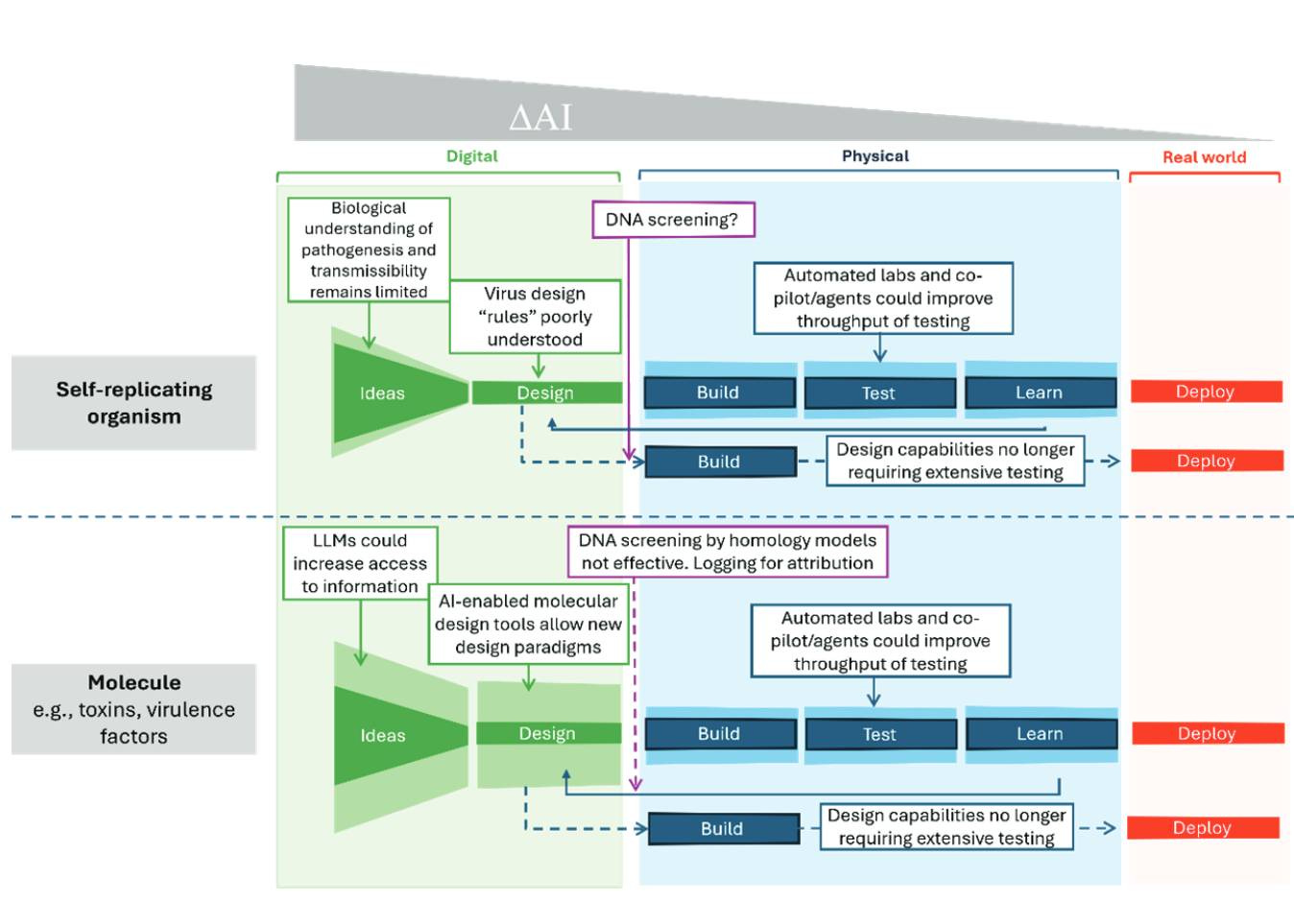
Artificial intelligence (AI) applications in the life sciences have the potential to enable advances in biological discovery and design at a faster pace and efficiency than is possible with classical experimental approaches alone. At the same time, AI-enabled biological tools developed for beneficial applications could potentially be misused for harmful purposes. Although the creation of biological weapons is not a new concept or risk, the potential for AI-enabled biological tools to affect this risk has raised concerns during the past decade.
This report, as requested by the Department of Defense, assesses how AI-enabled biological tools could uniquely impact biosecurity risk, and how advancements in such tools could also be used to mitigate these risks. The Age of AI in the Life Sciences reviews the capabilities of AI-enabled biological tools and can be used in conjunction with the 2018 National Academies report, Biodefense in the Age of Synthetic Biology, which sets out a framework for identifying the different risk factors associated with synthetic biology capabilities.
And the full table of contents:
ACRONYMS AND ABBREVIATIONS
PREFACE
SUMMARY
1 INTRODUCTION
The Convergence of AI and Life Sciences
Study Scope and Approach
Report Organization
2 DESIGN-BUILD-TEST-LEARN: IMPACT OF AI ON THE SYNTHETIC BIOLOGY PROCESS
Ideation and Design: Large Language Models and Foundation Models
Build and Test: Automated Laboratories
Learn: Synthetic Data
3 AI-ENABLED BIOLOGICAL DESIGN AND THE RISKS OF SYNTHETIC BIOLOGY
Addressing Biological Complexity in Design and Engineering
Implications for Biosecurity
Broader Context for Assessing Biosecurity Risks: The 2018 Framework
4 PROMOTING AND PROTECTING AI-ENABLED INNOVATION FOR BIOSECURITY
AI-Enabled Infectious Disease Biosurveillance
AI-Enabled Biodesign for Countermeasure Development and Emergency Response
AI and Biodesign Security
Balancing AI-Enabled Responses to Biological Threats and Potential Risks
5 IMPORTANCE OF DATA IN AI-ENABLED BIOLOGICAL MODELS
Biological Datasets for Training AI Models
Infrastructure and Governance
The Data Life Cycle and National Repositories
Considerations for Building Data Infrastructure
Protecting Data Assets for AI-Enabled Biological R&D
Data-Driven Vulnerabilities and Mitigations
APPENDIXES
A Mapping the Landscape of AI-Enabled Biological Design
B Public Meeting Agendas
C Committee Biographies